


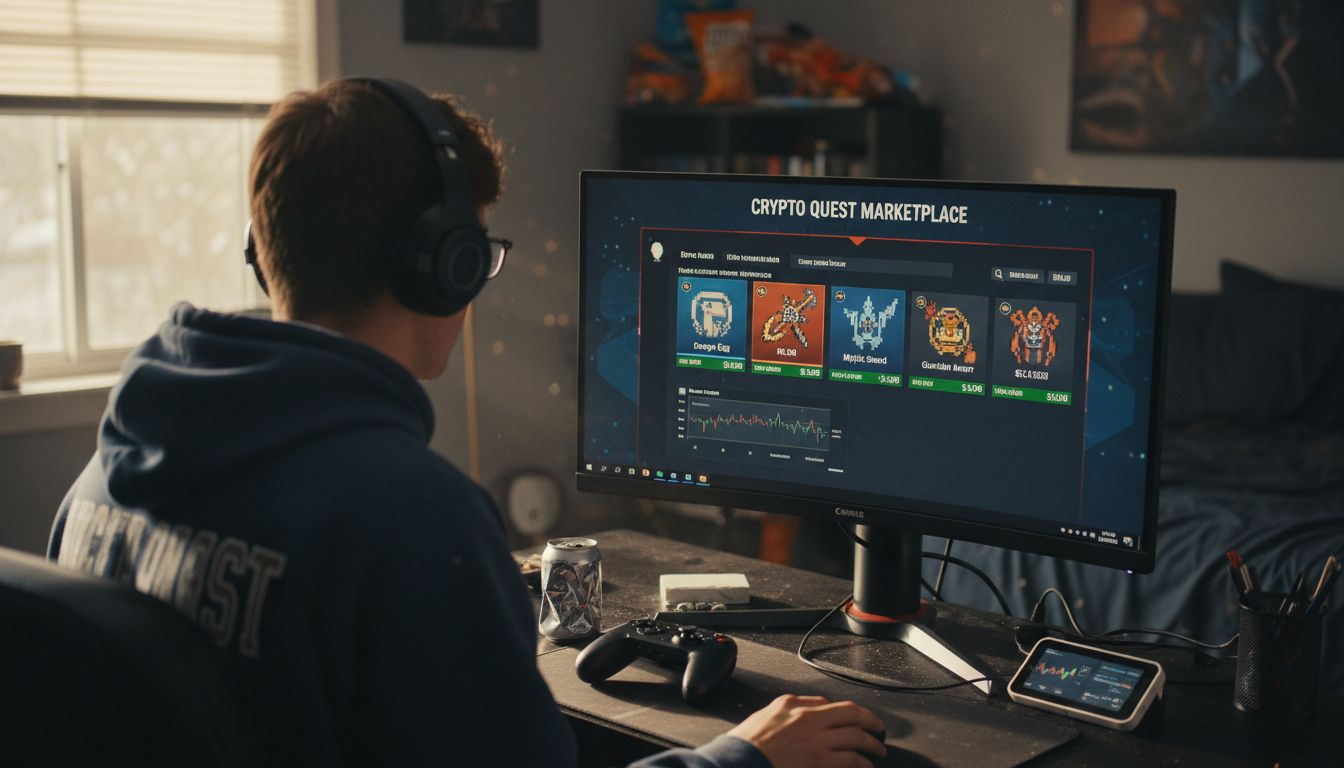
Many gamers mistakenly think blockchain gaming is just a way to make quick money. The true power is in giving players full ownership and control of digital items. The fundamental innovation of blockchain gaming is asset ownership and open economies, not mere speculation. This guide explains how blockchain changes gaming through ownership, economics, and innovation.
Table of Contents
- Introduction To Blockchain Gaming
- Core Technology Behind Blockchain Gaming
- Ownership And Economic Models In Blockchain Games
- Common Misconceptions And Criticisms
- Comparing Blockchain Gaming To Traditional Gaming
- Real-World Case Studies And Industry Examples
- Future Potential And Practical Takeaways
- Explore Blockchain Gaming Solutions With DailyTouch
- FAQ
Key Takeaways
| Point | Details |
|---|---|
| True digital ownership via NFTs enables player control over in-game assets. | Players can trade, sell, or use assets independently from game developers. |
| Play-to-earn models reward gameplay with real-world value. | Players earn cryptocurrencies or NFTs through game activities. |
| Blockchain gaming economies are open and interoperable unlike traditional closed systems. | Assets can move between platforms and retain value. |
| Environmental and scam concerns exist but are being addressed with new tech and regulation. | Proof-of-stake blockchains reduce energy use by over 99%. |
| Leading blockchain games show real economic impact and user adoption. | Axie Infinity generated millions in player earnings by 2022. |
Introduction to Blockchain Gaming
Blockchain gaming represents a fundamental shift from traditional gaming models. Unlike conventional games where developers control all assets, blockchain gaming allows players true ownership of in-game assets by storing items as NFTs on the blockchain. This means you control, trade, and sell items independently from game developers.
NFTs are tokenized digital assets that confer true ownership. When you earn or purchase an NFT sword or character skin, it exists on the blockchain under your wallet address. The game developer cannot delete it, and you can sell it to other players on open marketplaces. This contrasts sharply with traditional games where you merely license assets that remain on company servers.
Blockchain enables control, trading, and persistence of game assets beyond any single game. Your items exist independently, potentially usable across multiple compatible games. Early examples like CryptoKitties demonstrated this model in 2017, allowing players to breed, collect, and trade unique digital cats that lived on the Ethereum blockchain.
Key differences in blockchain gaming include:
- Players own assets permanently through NFT technology
- Open marketplaces enable real-world asset trading
- Assets persist even if a game shuts down
- Blockchain gaming basics provide foundational understanding
- NFT asset ownership transforms player relationships with digital items
This shift matters to gamers because it provides empowerment and asset security. You invest time earning items that hold actual value. Your achievements translate to portable, sellable assets rather than disappearing when you stop playing.
Core Technology Behind Blockchain Gaming
Smart contracts are self-executing programs that automate rules, asset trades, and game mechanics. They run on blockchain networks and execute automatically when conditions are met. For example, a smart contract might automatically transfer an NFT weapon to your wallet when you defeat a boss, with no intermediary needed.
Crypto wallets function as digital ID systems that allow players to control assets securely. Your wallet holds private keys proving ownership of NFTs and tokens. Think of it as a universal gaming passport that works across different blockchain games. When you connect your wallet to a game, it reads your assets and grants access accordingly.
Role of smart contracts in automating game logic and asset transfers is crucial. Fungible tokens like game currencies work similarly to traditional money, where each unit is identical and interchangeable. NFTs are unique items like special weapons or rare characters, each with distinct properties and value.
Hybrid game architecture combines on-chain and off-chain processes for scalability. Storing every game action on blockchain would be slow and expensive. Instead, games store critical assets and transactions on-chain while running gameplay mechanics off-chain. This balances security with performance.
Blockchain platforms like Ethereum blockchain gaming infrastructure commonly host gaming applications. Other platforms like Polygon, Solana, and Immutable X offer faster transactions and lower fees specifically optimized for gaming.
Key technical elements include:
- Smart contracts automate trustless transactions
- Wallets provide universal player identity across games
- Fungible tokens serve as in-game currencies
- NFTs represent unique collectible assets
- Hybrid architectures balance performance with security
- Blockchain technical foundations enable seamless gaming experiences
Pro tip: When choosing a blockchain game, consider the underlying technology and wallet compatibility for the best experience. Games on faster, cheaper networks like Polygon offer smoother gameplay than congested networks.
Ownership and Economic Models in Blockchain Games
NFTs confer true ownership of unique assets unlike traditional server-locked items. In conventional games, your legendary sword exists only as database entry the company controls. With NFTs, that sword is a blockchain token you genuinely own. The game cannot take it away or prevent you from selling it.
Play-to-earn games reward players with cryptocurrencies or NFTs based on gameplay activity, allowing earning real-world value alongside entertainment. Games like Axie Infinity pioneered this model, where players earn tokens by battling creatures, completing quests, and participating in the ecosystem. Some players in developing countries earned more than local minimum wages through play-to-earn games.
Tokenomics concepts influence supply, demand, and player rewards. Game developers design token systems with careful attention to inflation rates, burning mechanisms, and reward distribution. Well-designed tokenomics maintains value and player engagement, while poorly designed systems collapse as token values plummet.
Interoperability allows asset use and trading across multiple games and platforms. Imagine using your sword from Game A as a weapon in Game B, or displaying your character skin in a virtual world. While full interoperability remains limited, standards are emerging to enable cross-game asset compatibility.
Real-world examples demonstrate these models in action:
- Axie Infinity created a thriving play-to-earn model insights ecosystem
- The Sandbox enables user-generated NFT content and virtual real estate
- Decentraland offers a persistent virtual world with player-owned land
- Gods Unchained provides tradable card game assets
- Play-to-earn ecosystems showcase diverse gaming models
Pro tip: Evaluate tokenomics and marketplace health before investing time or money in blockchain games. Check token supply schedules, daily active users, and marketplace trading volumes to assess sustainability.
Common Misconceptions and Criticisms
Several myths surround blockchain gaming that need correction. First, blockchain games are not all quick-money schemes. While some players earn income, most play for entertainment with potential earnings as a bonus. Second, NFTs are not inherently worthless; they represent actual digital ownership with utility in games. Third, environmental harm is overstated for modern blockchain games.
Proof-of-stake blockchains reduce energy consumption drastically compared to older proof-of-work systems. Ethereum’s transition to proof-of-stake cut energy use by over 99%. Most new blockchain games launch on energy-efficient networks from the start.
Proof-of-stake consensus mechanisms consume over 99% less energy than proof-of-work systems, addressing environmental concerns that plagued early blockchain applications.
Risks of scams and regulatory uncertainties remain valid concerns requiring due diligence. The blockchain gaming space has seen rug pulls, where developers abandon projects after raising funds. Players should research team backgrounds, read smart contract audits, and start with established games. Regulatory frameworks are still developing, creating uncertainty around token classifications and tax treatment.
Technical issues like scalability challenge blockchain gaming adoption. Early blockchain games suffered from slow transaction speeds and high fees during network congestion. Hybrid solutions emerged where critical assets live on-chain while gameplay mechanics run off-chain on faster servers. Layer 2 scaling solutions like Polygon process transactions faster and cheaper.
Common criticisms and realities include:
- Environmental impact concerns are addressed by modern proof-of-stake networks
- Speculation risks exist but don’t define all blockchain gaming
- Common blockchain gaming misconceptions often ignore technological improvements
- Scalability challenges are being solved through hybrid architectures
- Regulatory uncertainty requires player awareness and caution
- Blockchain gaming myths frequently overlook genuine innovations
Comparing Blockchain Gaming to Traditional Gaming
Traditional games have closed economies and centralized asset control, while blockchain games offer open economies, true asset ownership, and play-to-earn incentives. The comparison reveals fundamental differences in how players interact with game economies.
| Feature | Traditional Gaming | Blockchain Gaming |
|---|---|---|
| Asset Ownership | Company owns all assets | Players own NFT assets |
| Economy Type | Closed, controlled by developers | Open, market-driven |
| Asset Trading | Restricted or forbidden | Free trading on marketplaces |
| Transparency | Opaque drop rates and mechanics | Verifiable on blockchain |
| Monetization | Pay-to-play or free-to-play with microtransactions | Play-to-earn with token rewards |
| Asset Persistence | Assets lost if game shuts down | Assets persist on blockchain |
Blockchain transparency reduces fraud and enables cross-game asset use. Players can verify drop rates, examine smart contract code, and confirm asset scarcity. Traditional games require trusting developers to honestly report probabilities and maintain fair systems.
The shift from pay-to-play to play-to-earn affects player incentives and engagement. Traditional games ask for money upfront or through purchases. Blockchain games can reward time investment with tradable tokens. This changes the relationship from pure entertainment expense to potential income source.
Advantages and limitations for gamers include:
- Blockchain advantages: true ownership, potential earnings, transparent mechanics, asset portability
- Blockchain limitations: technical complexity, market volatility, regulatory uncertainty, current scalability issues
- Traditional advantages: polish, established studios, simpler onboarding, no wallet requirements
- Traditional limitations: no ownership, closed economies, company control, no asset value outside game
- Gaming comparison insights help evaluate both models
- Ethereum gaming comparison shows technical tradeoffs
- Blockchain vs traditional gaming reveals evolving player preferences
Real-World Case Studies and Industry Examples
Axie Infinity’s ecosystem generated substantial player earnings, demonstrating real economic impact. Axie Infinity generated several million dollars in player earnings by 2022, illustrating the scale of blockchain play-to-earn ecosystems. Players bred, battled, and traded creature NFTs, with some earning enough to support families during the height of the game’s popularity.
The Sandbox’s user-created NFTs and vibrant marketplace showcase creative player empowerment. Users purchase virtual land plots, build experiences, and monetize creations. Brands like Atari and Snoop Dogg bought virtual real estate, legitimizing the concept. Players earn SAND tokens by creating and hosting games within The Sandbox metaverse.
CryptoKitties, an early blockchain game from 2017, provided valuable lessons. It demonstrated demand for blockchain collectibles but also exposed Ethereum’s scalability limits when the game congested the network. Some CryptoKitties sold for over $100,000, proving digital scarcity could command real value.
Innovative NFT uses in recent titles include:
- Dynamic NFTs that evolve based on player actions
- Fractionalized ownership of high-value game assets
- NFT rentals allowing players to borrow expensive items
- Cross-game asset compatibility through standardized metadata
- Blockchain gaming examples demonstrate diverse implementations
- Axie Infinity play-to-earn remains influential despite market shifts
Millions of dollars in player earnings across blockchain gaming ecosystems by 2022 validated the economic model and attracted mainstream attention to play-to-earn gaming.
Future Potential and Practical Takeaways
The blockchain gaming market is projected to grow from $8.5 billion in 2023 to $314.3 billion by 2030, reflecting rapid adoption and increasing player participation. This explosive growth signals mainstream acceptance and developer investment in blockchain gaming infrastructure.
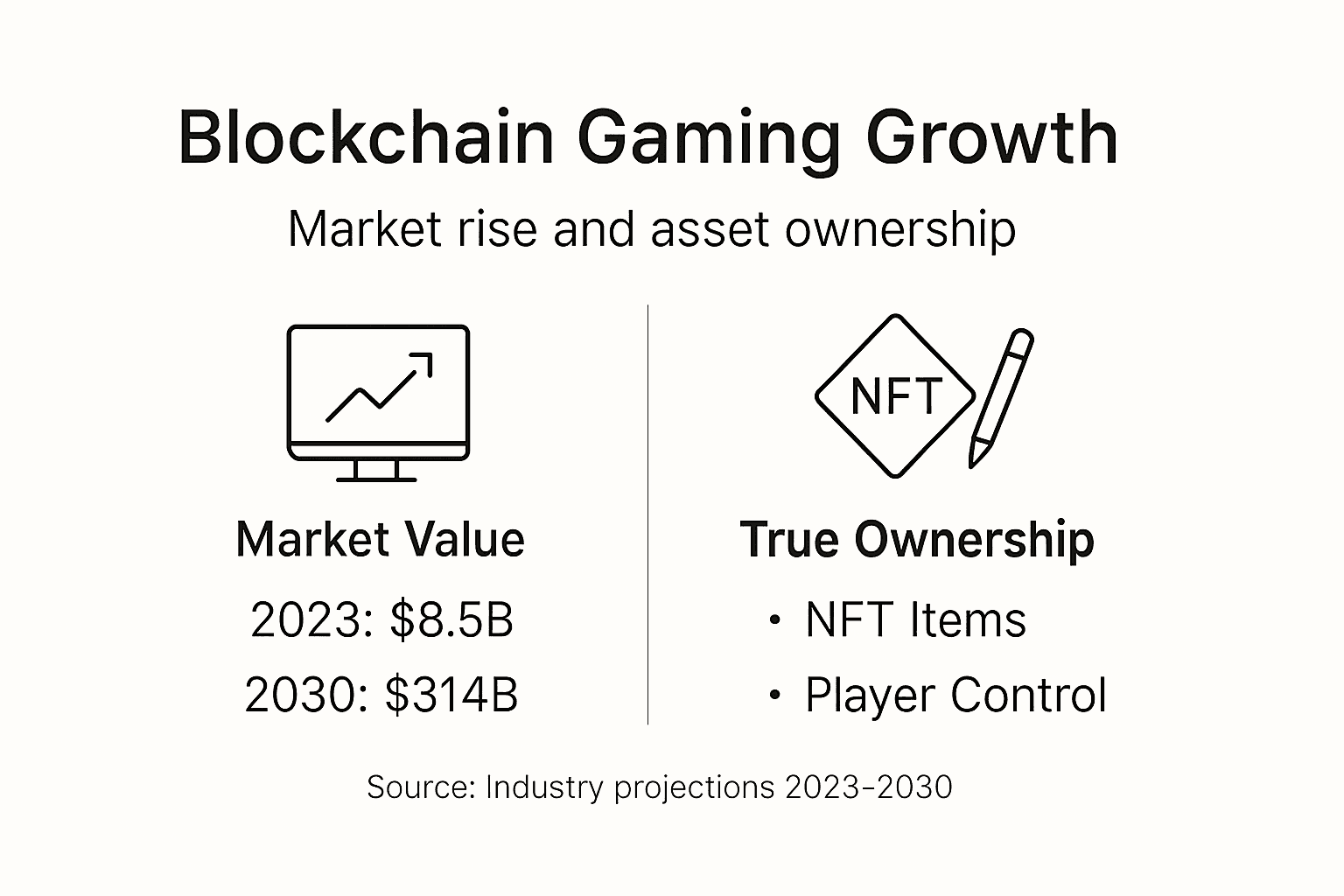
Potential for cross-game asset use and decentralized governance models could transform gaming. Imagine truly owning your character that travels between compatible games, maintaining progress and items. Decentralized autonomous organizations might let players vote on game development decisions, shifting power from studios to communities.
Challenges ahead include scalability, regulation, and user experience improvements. Blockchain games must become as smooth and intuitive as traditional games to achieve mass adoption. Regulatory clarity around token classifications and tax treatment would reduce uncertainty. Continued scaling solutions will enable more complex games on blockchain.
Practical advice for gamers new to blockchain gaming:
- Understand tokenomics before investing time or money in any game
- Use secure hardware wallets for valuable NFT assets
- Choose established platforms with active communities and transparent teams
- Start with small investments to learn mechanics without significant risk
- Research blockchain gaming market growth trends before committing
- Diversify across multiple games rather than concentrating in one ecosystem
Pro tip: Stay updated on protocol upgrades and community initiatives that can affect gameplay and assets. Follow official channels, join Discord communities, and monitor blockchain network announcements that might impact your games.
Explore Blockchain Gaming Solutions with DailyTouch
Blockchain gaming represents an exciting frontier where entertainment meets financial innovation. DailyTouch covers the latest crypto investment opportunities in gaming-related assets, emerging play-to-earn trends, and ecosystem developments. Whether you’re curious about NFT gaming projects or tracking top cryptocurrencies to watch that power blockchain games, our platform delivers fast, clear, and reliable insights.
Visit the DailyTouch homepage to explore curated crypto and blockchain news that keeps you informed about gaming innovations and investment opportunities in this rapidly evolving space.
FAQ
What is blockchain gaming?
Blockchain gaming is a genre where blockchain technology secures game assets and enables player ownership beyond traditional limits. Assets are often represented as NFTs allowing open trading and control. Players genuinely own items rather than licensing them from developers.
How do play-to-earn games work?
Players earn cryptocurrencies or NFTs by completing game tasks, winning battles, or trading assets. These rewards have real-world economic value that can be exchanged for traditional currency. The model turns gaming time into potential income alongside entertainment.
Are blockchain games environmentally friendly?
New proof-of-stake blockchains consume over 99% less energy than older proof-of-work systems. Many blockchain games run on these efficient platforms addressing environmental critiques. Modern blockchain gaming has minimal environmental impact compared to early implementations.
Can I use assets from blockchain games across different games?
Many blockchain games enable asset trading on open marketplaces independent of any single game. Interoperability across games is emerging but still limited, expected to expand with market growth. Standards are developing to enable broader cross-game compatibility.
What should I consider before playing blockchain games?
Research tokenomics and game community health before investing time or money. Use secure wallets and avoid speculative hype around unproven projects. Choose established platforms with good reputations, active development teams, and transparent communication.
Recommended
- Homepage – DailyTouch
- Ethereum 2029 Roadmap: ETH Aims to Become the High-Speed Internet of Value – DailyTouch
- Best Cryptocurrencies to Invest in 2026: Top 10 Picks
- Trump Media Expands Crypto Push with New ETF Filing Tied to Bitcoin, Ethereum, and Cronos – DailyTouch
Article generated by BabyLoveGrowth
