



By 2026, 65% of North American enterprises have integrated blockchain into their operations, transforming how businesses achieve transparency and efficiency. This shift from experimental technology to mainstream tool requires leaders to distinguish practical applications from hype. You will learn which blockchain trends deliver measurable competitive advantages, how to evaluate platforms strategically, and what risks to avoid when adopting this technology for your organization.
Table of Contents
- Understanding The Current Blockchain Landscape For Businesses
- How Blockchain Enhances Operational Efficiency And Security
- Common Misconceptions About Blockchain In Business
- Evaluating Blockchain Solutions: A Strategic Framework
- Real-World Business Case Studies And Applications
- Risks, Challenges, And Tradeoffs In Blockchain Adoption
- Implementing Blockchain For Competitive Advantage
- Explore Dailytouch For Blockchain Insights And Solutions
- Frequently Asked Questions About Blockchain Trends For Businesses
Key takeaways
| Point | Details |
|---|---|
| Widespread adoption | Majority of North American enterprises integrated blockchain by 2026, driven by transparency and efficiency gains. |
| Strategic evaluation needed | Success requires informed platform choices, clear objectives, and alignment with business goals. |
| Myths mislead decisions | Common misconceptions about accessibility and security can derail blockchain initiatives. |
| Framework reduces risk | Structured evaluation of scalability, security, and compliance increases implementation success. |
| Real results proven | Case studies show measurable benefits in healthcare, supply chain, and asset management with proper execution. |
Understanding the current blockchain landscape for businesses
The blockchain ecosystem has matured significantly beyond cryptocurrency origins. By 2026, 65% of North American enterprises integrated blockchain into their core operations, marking a decisive shift from experimental pilots to production deployments. This adoption wave reflects compelling business drivers rather than technology enthusiasm.
Key factors accelerating blockchain integration include:
- Improved transparency across complex supply chains and multi-party transactions
- Fraud reduction through immutable record keeping and cryptographic verification
- Operational efficiency gains from automated processes and reduced intermediaries
- Enhanced data security through distributed architecture and consensus mechanisms
Applications have expanded far beyond digital currencies. Asset tokenization now enables fractional ownership of real estate and fine art. Decentralized finance models reshape lending and investment across traditional industries. Healthcare organizations use blockchain for secure patient data sharing. Supply chain managers trace products from origin to consumer with unprecedented accuracy.
This evolution reflects blockchain’s versatility in solving business problems. The technology addresses challenges in trust, verification, and coordination that plague traditional systems. Organizations in finance, logistics, healthcare, and manufacturing find fundamental blockchain trends affecting businesses align with their operational needs. Understanding this landscape helps leaders identify where blockchain delivers genuine value versus where alternatives serve better.
How blockchain enhances operational efficiency and security
Blockchain’s core architecture creates specific operational advantages that traditional databases cannot replicate. The distributed ledger’s immutability means records cannot be altered retroactively without detection, reducing fraud and errors. Decentralized validation eliminates single points of failure while speeding transaction processing through parallel verification.
Blockchain reduces supply chain fraud by 30 to 40% through transparent tracking of goods and automated verification at each transfer point. In healthcare, the technology lowers data breach risk by 20% by distributing sensitive information across nodes rather than centralizing it in vulnerable databases. These improvements translate directly to cost savings and risk reduction.
Key features driving efficiency gains:
- Distributed ledger technology eliminates reconciliation delays between parties
- Smart contracts automate execution when predefined conditions are met
- Consensus mechanisms validate transactions without central authority overhead
- Cryptographic security reduces authentication costs and breach exposure
- Real-time visibility accelerates decision making across organizations
Process improvements deliver 20 to 40% efficiency gains in supply chain operations and data handling workflows. Automated verification through smart contracts removes manual review steps that create bottlenecks. Real-time access to validated data enables faster responses to supply disruptions or compliance requirements.
Organizations achieving 35% faster processing times report blockchain’s transparency as the primary driver. This speed advantage compounds across complex workflows involving multiple parties. The quantified benefits of blockchain become most apparent in industries with high transaction volumes, multiple stakeholders, and strict audit requirements where traditional systems struggle to maintain pace and accuracy.

Common misconceptions about blockchain in business
Several persistent myths prevent leaders from making informed blockchain decisions. The belief that blockchain suits only large enterprises ignores compelling evidence. 52% of mid-sized businesses report positive ROI within 18 months of implementation, demonstrating scalability across organization sizes. Resource constraints matter less than strategic alignment and clear use cases.
Security misconceptions prove particularly costly. Blockchain architecture provides strong foundations, but 35% of blockchain projects have security vulnerabilities due to poor implementation and inadequate auditing. The technology does not guarantee security automatically. Smart contract bugs, weak key management, and insufficient access controls create exploitable weaknesses regardless of underlying blockchain strength.
Implementation complexity varies dramatically based on use case selection and platform choice. Simple supply chain tracking requires far less technical expertise than building decentralized finance applications. Organizations selecting appropriate platforms and scoping projects realistically avoid the complexity trap that derails ambitious initiatives.
Common myths that mislead decision makers:
- Blockchain eliminates all intermediaries and transaction costs
- Every business process benefits from blockchain integration
- Private blockchains offer no advantages over traditional databases
- Blockchain adoption requires complete system replacement
- Regulatory uncertainty makes blockchain too risky for adoption
Pro Tip: Evaluate blockchain suitability by identifying specific trust, verification, or coordination problems in your operations. Pilot small, measurable projects with expert guidance rather than pursuing blockchain for its innovation appeal. Clear success criteria and realistic timelines prevent common blockchain adoption pitfalls that waste resources and damage credibility.
Evaluating blockchain solutions: a strategic framework
Successful blockchain adoption requires systematic evaluation of platforms and projects against business requirements. Five criteria form the foundation for strategic assessment: scalability, security, interoperability, regulatory compliance, and total cost of ownership. Weighing these factors against specific use cases prevents mismatched technology choices.
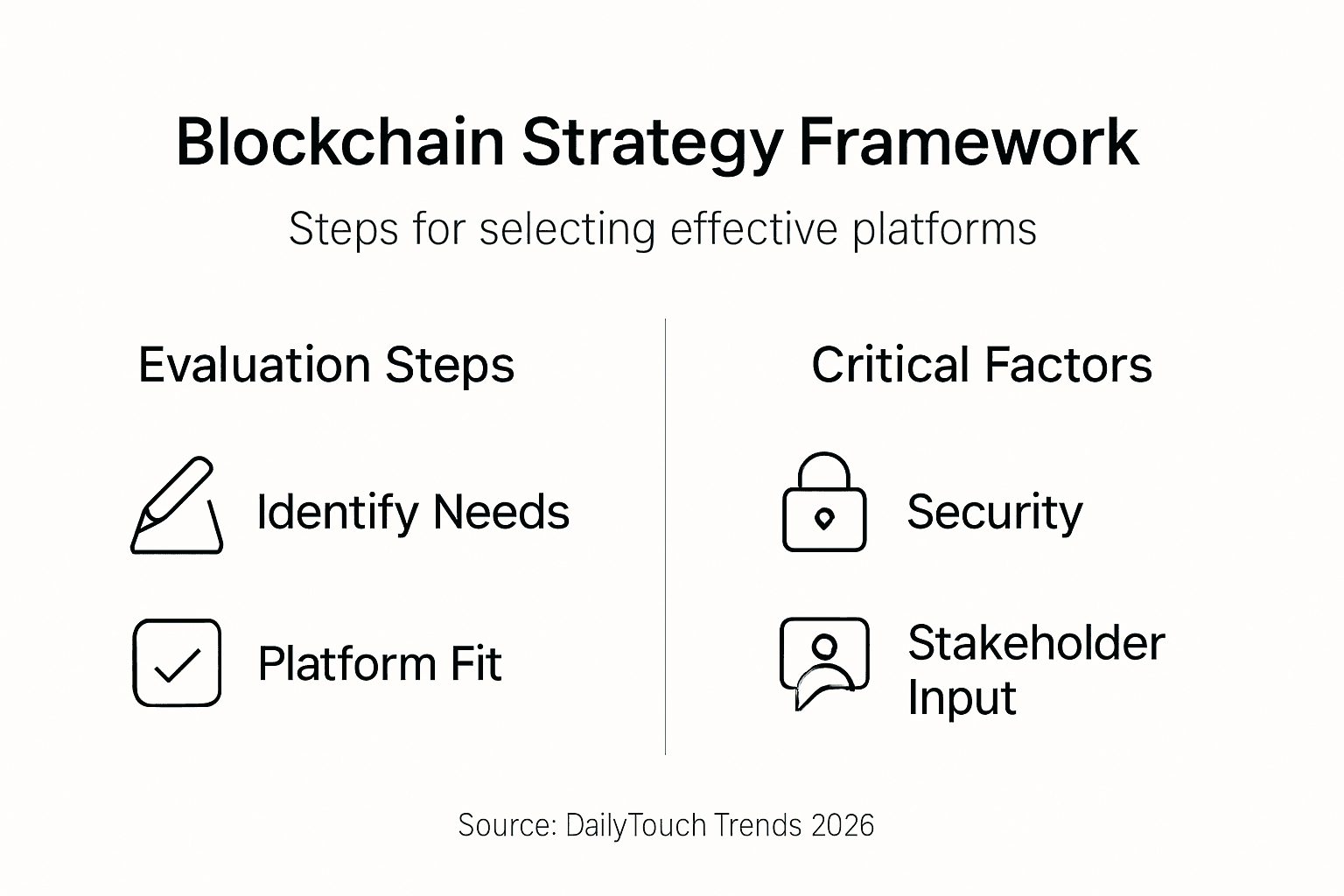
Ethereum excels at public smart contracts while Hyperledger Fabric suits enterprise consortia with better scalability for private networks. Ethereum’s strength lies in asset tokenization and decentralized applications requiring broad accessibility. Hyperledger’s permissioned model fits organizations needing controlled access and higher transaction throughput for internal processes.
| Platform | Best Use Cases | Key Strengths | Primary Limitations |
|---|---|---|---|
| Ethereum | Public smart contracts, asset tokenization, DeFi | Large developer community, proven security, flexibility | Higher transaction costs, slower speeds |
| Hyperledger Fabric | Private enterprise networks, supply chain | High throughput, permissioned access, modular architecture | Limited public visibility, requires more setup |
| Corda | Financial services, regulated industries | Privacy features, regulatory compliance focus | Narrower use case fit, smaller ecosystem |
Alignment between blockchain capabilities and business objectives determines project success. Organizations launching pilots without clear problems to solve face 60% failure rates. Define specific metrics for measuring blockchain’s impact before selecting platforms or building applications.
Evaluation checklist for blockchain initiatives:
- Does the use case involve multiple parties requiring shared truth?
- Will immutable records provide audit or compliance benefits?
- Can smart contracts reduce manual processes meaningfully?
- Does current infrastructure create trust or verification bottlenecks?
- Will blockchain integration costs justify efficiency gains within 24 months?
Pro Tip: Engage legal, compliance, and IT stakeholders early in platform evaluation. Their input on regulatory requirements, integration constraints, and security standards prevents costly pivots later. Compare Ethereum platform benefits against enterprise alternatives using actual workflow requirements rather than feature checklists. Review blockchain platform comparison studies to understand tradeoffs before committing resources to specific technologies.
Real-world business case studies and applications
North American organizations demonstrate blockchain’s practical value across diverse sectors. Healthcare networks reduced patient data access times by 25% through blockchain-based sharing systems. This improvement enabled faster care coordination between specialists and primary physicians while maintaining privacy compliance. The technology solved persistent interoperability challenges that traditional health information exchanges struggled to address.
Supply chain deployments achieved 30 to 40% fraud reduction through end-to-end product traceability. Pharmaceutical companies track medications from manufacturing through distribution, eliminating counterfeit drugs from legitimate supply chains. Food retailers trace produce origins within seconds during contamination investigations, protecting consumers and brand reputation.
Asset tokenization increased investment liquidity by 50% for previously illiquid assets. Real estate projects offer fractional ownership through blockchain tokens, lowering investment minimums from hundreds of thousands to thousands of dollars. This democratization expands investor access while providing property developers with new capital sources.
Successful implementations share common characteristics:
- Clear business problems addressed rather than technology-first approaches
- Strong stakeholder alignment across participating organizations
- Phased rollouts starting with constrained pilots before full deployment
- Continuous monitoring and optimization based on performance metrics
- Executive sponsorship maintaining momentum through implementation challenges
Decentralized finance models extend beyond cryptocurrency trading into mainstream business applications. Companies use DeFi protocols for cross-border payments, reducing transfer times from days to minutes while cutting fees by 60%. Supply chain finance platforms automate invoice factoring through smart contracts, improving cash flow for small suppliers.
These case studies illustrate how pilot projects transition to scalable applications. Organizations achieving measurable blockchain benefits focus on specific workflows where blockchain’s unique properties solve existing pain points. They avoid blockchain-for-blockchain’s-sake initiatives that lack clear value propositions and struggle to justify ongoing investment.
Risks, challenges, and tradeoffs in blockchain adoption
Blockchain projects face significant failure risks despite compelling benefits. 60% of pilots fail to progress beyond initial phases, typically due to unclear objectives and poor stakeholder alignment. Organizations launching initiatives without defining success criteria or securing cross-functional buy-in waste resources and damage blockchain credibility internally.
Security vulnerabilities frequently arise from implementation gaps rather than blockchain architecture flaws. Lacking continuous security audits and governance processes leaves smart contracts exposed to exploitation. Organizations must budget for ongoing security reviews, penetration testing, and code audits beyond initial development costs.
Cost-benefit analysis proves complex in blockchain projects. Evolving technology standards and shifting regulatory requirements create uncertainty in long-term ROI calculations. Leaders must weigh innovation potential against implementation costs while acknowledging that some benefits emerge only after reaching network effects with partners.
Common implementation challenges:
- Integration with legacy systems requiring significant middleware development
- Skill gaps in blockchain development and architecture within IT teams
- Regulatory uncertainty requiring flexible designs adaptable to changing rules
- Partner coordination complexity when multiple organizations share networks
- Change management resistance from employees comfortable with existing processes
Organizations must balance innovation speed with security and compliance needs. Rapid deployment increases competitive advantage but elevates risk exposure. Excessive caution delays benefits and allows competitors to capture first-mover advantages. Finding the right pace requires honest assessment of internal capabilities and risk tolerance.
Ongoing risk management and clear KPIs mitigate common pitfalls. Establish security review cadences before vulnerabilities manifest. Define specific performance metrics tied to business outcomes rather than technical achievements. Monitor regulatory developments and maintain design flexibility to adapt quickly. Address blockchain project risk management proactively rather than reacting to problems after they impact operations or reputation.
Implementing blockchain for competitive advantage
Strategic blockchain integration requires systematic approaches focused on high-impact applications. Leaders who identify business challenges uniquely addressed by blockchain create stronger value propositions than those pursuing blockchain for innovation appearance. Target workflows where trust, verification, or coordination problems create measurable inefficiencies.
Actionable steps for successful blockchain adoption:
- Map existing processes to identify trust gaps, verification bottlenecks, and coordination failures that blockchain specifically solves
- Engage stakeholders across departments early to secure buy-in and surface integration requirements before design locks in
- Launch constrained pilots with measurable KPIs focused on business outcomes rather than technical metrics
- Implement continuous security auditing from project inception through production operations
- Establish governance frameworks defining roles, responsibilities, and decision rights for blockchain networks
- Measure and communicate ROI clearly using business language rather than technical jargon to sustain leadership support
- Plan scaling pathways from pilot to production, including infrastructure, partners, and operational processes
Prioritize use cases where blockchain delivers advantages over existing alternatives. Supply chain traceability, cross-organization data sharing, and automated settlement workflows often provide clearer ROI than applications where databases suffice. Avoid forcing blockchain into problems it does not solve better than simpler technologies.
Stakeholder engagement extends beyond internal teams to partners, regulators, and customers affected by blockchain implementations. Their input shapes realistic requirements and identifies constraints early when adjustments cost less. Building shared understanding prevents misaligned expectations that derail projects during execution.
Pro Tip: Focus on scalable, high-impact applications for sustainable competitive advantage rather than impressive but narrow use cases. Choose blockchain platforms with strong developer communities and proven enterprise adoption. Budget for ongoing optimization and governance, not just initial implementation. Success requires treating blockchain as a strategic capability requiring continuous investment rather than a one-time technology deployment.
Explore DailyTouch for blockchain insights and solutions
Navigating blockchain adoption requires staying current with rapidly evolving technology and business applications. DailyTouch delivers in-depth analysis and real-time updates on blockchain adoption benefits across industries, helping you make informed decisions backed by data and case studies.

Our platform covers emerging trends shaping business innovation, from crypto ETF developments to enterprise blockchain deployments. You will find practical guidance on evaluating platforms, managing implementation risks, and measuring ROI to justify continued investment. Visit DailyTouch to access expert analysis and stay ahead of blockchain trends transforming competitive landscapes in your industry.
Frequently asked questions about blockchain trends for businesses
What industries in North America benefit most from blockchain in 2026?
Financial services, supply chain and logistics, healthcare, and real estate show the strongest blockchain adoption and ROI. These sectors face complex multi-party transactions, strict regulatory requirements, and high costs from fraud or inefficiency that blockchain addresses effectively.
How can mid-sized businesses start blockchain adoption with limited resources?
Begin with constrained pilots addressing specific pain points like supply chain visibility or contract automation. Partner with blockchain-as-a-service providers to reduce infrastructure costs and technical complexity. Focus on use cases delivering measurable ROI within 18 months to justify expansion.
What are key factors to ensure blockchain project security?
Implement continuous security audits throughout development and operations. Use established platforms with proven security track records rather than building from scratch. Establish strong key management, access controls, and governance processes. Budget for ongoing penetration testing and code reviews.
How does blockchain adoption ROI typically timeline look?
Most organizations see positive ROI within 18 to 24 months of production deployment. Pilot phases typically run 6 to 12 months before scaling decisions. Time to value depends on use case complexity, integration requirements, and partner coordination needs.
What distinguishes scalable blockchain applications from pilot projects?
Scalable applications solve problems affecting core business processes with clear efficiency or cost advantages. They include governance frameworks, partner onboarding processes, and integration with existing systems. Pilots often test technical feasibility without addressing operational requirements for production use.