



Over 60% of new crypto investors confuse tokens with coins, missing fundamental differences that affect investment decisions and legal treatment. This confusion stems from complex blockchain terminology and varied token functions beyond simple currency. Understanding crypto tokens clearly helps you navigate regulatory requirements, assess investment risks accurately, and identify genuine opportunities in the expanding digital asset market across DeFi, governance, and ownership applications.
Table of Contents
- Understanding Crypto Tokens: Definition and Core Concepts
- How Crypto Tokens Work and How They Are Created
- Types of Crypto Tokens: Fungible vs Non-Fungible and Their Uses
- Regulatory Status of Crypto Tokens in the U.S.
- Common Misconceptions About Crypto Tokens
- Use Cases and Practical Applications of Crypto Tokens
- Security and Storage of Crypto Tokens
- Conclusion: Navigating the Crypto Token Landscape for Investment and Innovation
- Frequently Asked Questions About Crypto Tokens
Key Takeaways
| Point | Details |
|---|---|
| Tokens vs Coins | Tokens are digital assets built on existing blockchains, while coins have their own native blockchains. |
| Fungibility Matters | Fungible tokens are interchangeable like currency; non-fungible tokens represent unique, indivisible assets. |
| U.S. Regulation | The SEC applies the Howey Test to determine if tokens qualify as securities based on profit expectations. |
| Diverse Applications | Tokens enable governance, staking, fractional ownership, and access rights far beyond payment functions. |
| Security Essential | Hardware wallets and multi-factor authentication protect tokens from theft and unauthorized access. |
Understanding Crypto Tokens: Definition and Core Concepts
Crypto tokens are digital assets developed on existing blockchain platforms, distinguishing them from coins that operate on their own native blockchains. Bitcoin runs on the Bitcoin blockchain as a coin. Ethereum’s ETH is also a coin on the Ethereum blockchain. However, thousands of tokens exist on Ethereum and other platforms without owning their underlying infrastructure.
This technical distinction creates functional differences. Coins primarily serve as currency or store of value within their ecosystems. Tokens represent diverse assets including ownership stakes, governance rights, access credentials, or unique collectibles depending on their design and purpose.
Blockchain platforms supporting tokens include Ethereum, Binance Smart Chain, Solana, and Polygon. These networks provide the infrastructure and security while tokens leverage smart contracts to define their specific rules and behaviors. Ethereum hosts the majority of tokens due to its mature ecosystem and developer tools.
Common token functionalities include:
- Representing fractional ownership in real world assets like real estate or commodities
- Granting voting power in decentralized autonomous organizations for protocol governance
- Providing access to exclusive services, content, or platform features
- Enabling staking rewards and yield generation in DeFi protocols
- Certifying authenticity and ownership of digital art or collectibles
Understanding these distinctions helps you evaluate token projects accurately and recognize which blockchain infrastructure supports your investments.
How Crypto Tokens Work and How They Are Created
Token creation relies on smart contracts, which are self-executing programs stored on blockchains that automatically enforce predefined rules. Developers write contract code specifying token supply, distribution methods, transfer rules, and special features. Once deployed to a blockchain, the smart contract manages all token operations without centralized control.
ERC-20 is the dominant token standard on Ethereum, establishing common rules that ensure tokens work seamlessly across wallets, exchanges, and applications. This standardization enables interoperable token creation by defining six mandatory functions including total supply tracking, balance queries, and transfer mechanisms. Other standards like ERC-721 for NFTs and BEP-20 on Binance Smart Chain follow similar principles.
Blockchain interoperability allows some tokens to move between different networks through bridges or wrapped versions. Wrapped Bitcoin exists as an ERC-20 token on Ethereum, enabling Bitcoin holders to participate in Ethereum DeFi while maintaining Bitcoin price exposure. Cross-chain bridges lock tokens on one network and mint equivalent versions on another.
The token creation workflow typically follows these steps:
- Define token specifications including name, symbol, total supply, and decimal precision
- Write or customize smart contract code following established standards like ERC-20
- Test contract functionality thoroughly on test networks before mainnet deployment
- Deploy the finalized contract to the chosen blockchain by paying gas fees
- Verify contract source code publicly to enable community auditing and trust
- List token on exchanges and integrate with wallets for accessibility
Pro Tip: Use established token standards like ERC-20 to ensure better compatibility with existing infrastructure and reduce security vulnerabilities from custom implementations.
Types of Crypto Tokens: Fungible vs Non-Fungible and Their Uses
Fungible tokens are interchangeable and divisible assets where each unit holds identical value. One USDC stablecoin equals any other USDC, just as one dollar bill equals another. You can split fungible tokens into smaller fractions, send partial amounts, and combine them freely. Most cryptocurrencies and utility tokens fall into this category.
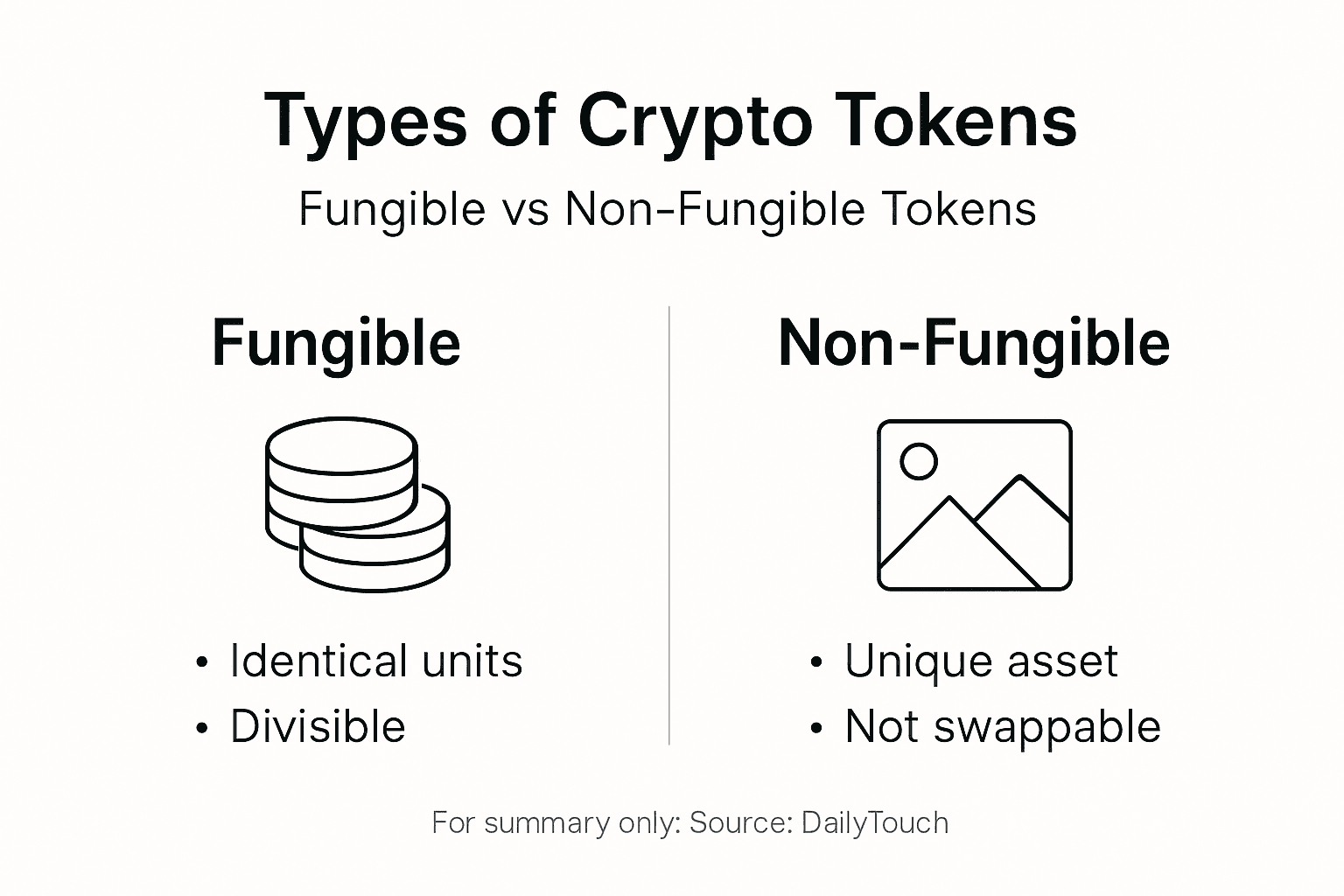
Non-fungible tokens represent unique, indivisible digital assets that cannot be exchanged on a one-to-one basis. Each NFT carries distinct properties, ownership history, and metadata making it irreplaceable. Digital art NFTs, virtual real estate parcels, and gaming items exemplify non-fungible assets where uniqueness drives value.
| Property | Fungible Tokens | Non-Fungible Tokens |
|---|---|---|
| Interchangeability | Fully interchangeable | Unique and distinct |
| Divisibility | Can split into fractions | Indivisible whole units |
| Value Determination | Identical unit value | Individual characteristics |
| Common Uses | Currency, stablecoins, governance | Art, collectibles, certificates |
| Standards | ERC-20, BEP-20 | ERC-721, ERC-1155 |
The NFT market capitalization surpassed $10 billion globally in 2025, demonstrating rapid growth in unique digital asset adoption. Major brands, artists, and creators launched NFT collections for fan engagement, royalty automation, and new revenue streams. Gaming companies integrated NFTs for true asset ownership and player-driven economies.
Fungible and non-fungible tokens serve distinct purposes across industries:
- Payment and remittance systems using stablecoins for fast, low-cost transfers
- Decentralized finance protocols offering lending, borrowing, and yield farming
- Loyalty programs rewarding customer engagement with redeemable tokens
- Gaming ecosystems enabling item trading and play-to-earn mechanics
- Digital identity verification and credential certification
- Supply chain tracking with unique item identifiers
Regulatory Status of Crypto Tokens in the U.S.
The SEC applies the Howey Test to determine if tokens qualify as securities based on four criteria: investment of money, common enterprise, expectation of profits, and reliance on others’ efforts. Tokens passing this test face strict securities regulations including registration requirements, disclosure mandates, and trading restrictions. Many utility tokens avoid securities classification by emphasizing functional use over investment returns.
The IRS treats cryptocurrencies including tokens as property for tax purposes, requiring investors to report capital gains or losses on every transaction. Selling tokens, trading them for other crypto, or using them to purchase goods triggers taxable events. You must track acquisition cost basis, holding periods, and fair market values at transaction times for accurate reporting.
FATF global standards addressing virtual assets have been adopted by over 100 countries including the U.S. as of 2025. These guidelines mandate anti-money laundering measures, customer due diligence, and travel rule compliance for crypto service providers. Enhanced regulatory coordination aims to prevent illicit finance while supporting legitimate innovation.
Key regulatory considerations for token investors include:
- Verify whether tokens are registered securities before investing in offerings
- Maintain detailed transaction records for tax reporting and audit defense
- Use compliant exchanges implementing KYC and AML procedures
- Monitor evolving state and federal regulations affecting token trading
- Consult tax professionals familiar with crypto property treatment
Understanding the U.S. crypto regulatory landscape helps you avoid legal pitfalls and structure investments appropriately.
Pro Tip: Stay informed on evolving regulations by following SEC guidance updates and consulting qualified legal advisors before participating in token offerings.
Common Misconceptions About Crypto Tokens
Surveys indicate over 60% of new crypto investors confuse tokens with coins, leading to poor investment choices and misunderstood risks. This confusion persists despite clear technical differences in blockchain architecture and asset purpose. Recognizing these distinctions prevents costly mistakes and enables accurate project evaluation.
Tokens differ from coins both technically and functionally. Coins operate independent blockchains securing their networks through mining or staking. Tokens rely on established blockchains for security and transaction processing. This dependency affects performance, fees, and upgrade paths differently than native coins experience.

Not all tokens qualify as securities under U.S. law. Classification depends on token structure, marketing, and whether buyers expect profits from others’ efforts. Utility tokens providing platform access without investment characteristics may avoid securities designation. However, aggressive promotion emphasizing returns often triggers regulatory scrutiny regardless of intended function.
Tokens serve purposes far beyond payment processing. While some function as digital currency, most enable specialized applications impossible with simple coins. Governance tokens grant voting rights in protocol decisions. Security tokens represent equity or debt instruments. NFTs certify unique asset ownership. Access tokens unlock premium features or content.
Top misconceptions and corrections include:
- Misconception: All tokens are cryptocurrencies used for payments. Reality: Most tokens represent governance rights, assets, or access rather than functioning as currency.
- Misconception: Tokens and coins are interchangeable terms. Reality: Coins have native blockchains while tokens are built on existing platforms with fundamental architectural differences.
- Misconception: Buying any token guarantees investment returns. Reality: Token value depends on utility, adoption, and project success with no return guarantees and substantial risk.
Understanding these facts through resources addressing common token misconceptions sharpens investment judgment and reduces vulnerability to scams.
Use Cases and Practical Applications of Crypto Tokens
Tokens enable governance and voting rights in decentralized protocols where holders propose and decide on upgrades, parameter changes, and treasury allocations. Uniswap’s UNI token grants voting power proportional to holdings, creating stakeholder alignment without centralized control. This democratic governance model distributes decision authority across active community members.
The DeFi market exceeded $150 billion total value locked in 2025, showcasing extensive token use in lending, borrowing, and yield generation. Users deposit tokens as collateral to borrow other assets, earn interest on lending, or provide liquidity for trading fees. Staking tokens in validation or liquidity pools generates passive income while supporting network operations.
Fractional ownership tokens democratize access to expensive assets by dividing them into affordable shares. Real estate properties tokenized on blockchains allow investors to buy fractional interests with lower capital requirements and increased liquidity. Artwork, collectibles, and commodities similarly benefit from tokenization enabling broader participation.
Tokenization bridges digital tokens with physical assets through legal structures ensuring ownership rights. Smart contracts automate dividend distributions, transfer restrictions, and compliance requirements traditionally handled by intermediaries. This efficiency reduces costs and settlement times while maintaining regulatory compliance.
Key practical applications across industries include:
- Decentralized finance protocols offering non-custodial lending, trading, and derivatives
- Gaming ecosystems with player-owned items tradeable across games and marketplaces
- Supply chain verification tracking product authenticity and movement
- Content creator monetization through NFTs and social tokens
- Loyalty programs with transferable, tradeable reward points
- Fundraising through token sales and initial exchange offerings
Exploring real-world token use cases reveals innovation potential beyond speculative trading.
Security and Storage of Crypto Tokens
Hardware wallet adoption increased 40% in 2025 among U.S. crypto investors due to superior offline security protecting private keys from internet-connected threats. Devices like Ledger Nano X and Trezor Model T store keys in secure chips isolated from computers and phones. Transactions require physical confirmation on the device, preventing remote theft even if your computer is compromised.
Hot wallets remain connected to the internet for convenient access and frequent transactions but face higher hacking risks. Software wallets on phones and computers, exchange accounts, and browser extensions fall into this category. While suitable for small amounts and active trading, hot storage exposes larger holdings to malware, phishing, and platform breaches.
| Storage Type | Pros | Cons |
|---|---|---|
| Hot Wallets | Instant access, easy transactions, free options | Vulnerable to hacking, phishing, platform failures |
| Cold Wallets | Offline security, full control, immune to remote attacks | Higher cost, less convenient, physical loss risk |
Implementing crypto token storage best practices significantly reduces theft and loss risks. Use hardware wallets for long-term holdings exceeding amounts you can afford to lose. Keep only trading funds on exchanges to minimize exposure to platform security breaches. Distribute large holdings across multiple wallets to avoid single points of failure.
Pro Tip: Enable multi-factor authentication on all accounts and store backup seed phrases securely offline in multiple physical locations like safes or safety deposit boxes.
General security measures include:
- Verify website URLs carefully to avoid phishing sites mimicking legitimate platforms
- Never share private keys or seed phrases with anyone under any circumstances
- Use unique, strong passwords for each crypto service and wallet
- Research wallet and exchange security histories before trusting funds
- Test small transactions before moving large amounts to new addresses
Conclusion: Navigating the Crypto Token Landscape for Investment and Innovation
Crypto tokens represent diverse digital assets built on existing blockchains, serving functions from governance to fractional ownership beyond simple currency. Understanding the distinction between fungible and non-fungible tokens, along with their technical creation through smart contracts and standards like ERC-20, forms the foundation for informed participation.
U.S. regulatory frameworks apply the Howey Test to determine securities status while the IRS treats tokens as property requiring capital gains reporting. Staying current with evolving regulations protects you from compliance risks and legal complications. Over 100 countries now implement FATF standards affecting cross-border token transactions.
Secure storage using hardware wallets and multi-factor authentication prevents theft of valuable digital assets. Recognizing common misconceptions like confusing tokens with coins or assuming all tokens are securities sharpens investment judgment. Token applications span DeFi protocols, gaming ecosystems, real estate tokenization, and creator monetization.
Approach crypto tokens with careful research, understanding both opportunities and risks inherent in emerging technologies. Evaluate projects based on utility, team credibility, regulatory compliance, and sustainable business models rather than hype or promised returns. Continuous education through trusted sources keeps you informed as the ecosystem evolves rapidly.
Make deliberate, well-informed decisions backed by thorough due diligence and risk assessment appropriate to your financial situation.
Explore Trusted Crypto Investment Insights and Tools at DailyTouch
Navigating crypto tokens effectively requires access to current market intelligence and vetted investment analysis. DailyTouch delivers expert insights on the best cryptocurrencies to invest in 2026, helping you identify promising opportunities while avoiding overhyped projects. Our platform curates research on emerging tokens, established protocols, and market trends shaping the digital asset landscape.
Develop robust crypto investment strategies tailored to your risk tolerance and financial goals through our comprehensive guides covering portfolio diversification, security practices, and regulatory considerations. Stay informed about latest crypto ETF filings expanding institutional access and mainstream adoption. Visit DailyTouch for reliable crypto news, analysis, and tools supporting informed investment decisions.
Frequently Asked Questions About Crypto Tokens
What is the main difference between a crypto token and a coin?
Coins operate on their own native blockchains like Bitcoin on Bitcoin’s network or ETH on Ethereum. Tokens are built on existing blockchain platforms using smart contracts without owning underlying infrastructure. This technical distinction affects security models, transaction fees, and functional capabilities significantly.
Are all crypto tokens considered securities in the U.S.?
No, only tokens meeting the Howey Test criteria qualify as securities requiring SEC registration. Utility tokens providing platform access without profit expectations may avoid securities classification. However, token structure, marketing, and investor expectations all influence regulatory treatment, making case-by-case analysis essential.
How can I safely store my crypto tokens?
Use hardware wallets like Ledger or Trezor for long-term holdings, keeping private keys offline and protected from internet threats. Enable multi-factor authentication on all accounts and store backup seed phrases securely in multiple physical locations. Keep only active trading amounts on exchanges to minimize platform breach exposure.
What are some common uses of crypto tokens beyond payments?
Tokens enable decentralized governance through voting rights, fractional real estate ownership, gaming item trading, access to exclusive content, and DeFi yield generation. NFTs certify digital art ownership while security tokens represent equity or debt instruments. These diverse applications extend far beyond simple currency functions.
Why do I need to understand token types before investing?
Fungible and non-fungible tokens carry different risk profiles, liquidity characteristics, and valuation methods requiring distinct evaluation approaches. Misunderstanding token classification leads to inappropriate expectations and poor investment decisions. Regulatory treatment, tax implications, and market dynamics vary significantly between token types, making informed classification essential for sound investing.