



Many people think blockchain equals Bitcoin and cryptocurrency, but that’s just scratching the surface. Blockchain is a decentralized digital ledger technology reshaping industries from healthcare to supply chain management. This guide breaks down blockchain concepts clearly for beginners, explaining how it works, dispelling common myths, and exploring real world applications beyond crypto.
Table of Contents
- What Is Blockchain? Simple Explanation
- Origins And Evolution Of Blockchain
- How Blockchain Works: Architecture And Performance
- Common Misconceptions About Blockchain
- Practical Applications Beyond Cryptocurrency
- Future And Enterprise Adoption
- Explore Blockchain Insights And Solutions At Dailytouch
Key takeaways
| Point | Details |
|---|---|
| Blockchain is a decentralized ledger | Unlike traditional databases, blockchain distributes data across thousands of computers, eliminating central control and single points of failure. |
| Consensus mechanisms validate transactions | Proof of Work and Proof of Stake enable secure transaction validation without central authority, though each has distinct energy and speed characteristics. |
| Immutability has exceptions | While blockchain data is extremely difficult to alter, rare events like hard forks demonstrate possible changes through network consensus. |
| Applications extend beyond crypto | Industries including supply chain, healthcare, voting, and education leverage blockchain for transparency, security, and traceability. |
| Enterprise adoption is accelerating | The enterprise blockchain market is projected to reach $936 billion by 2030, driven by tokenization and digital identity solutions. |
What is blockchain? Simple explanation
Blockchain is a decentralized ledger shared across thousands of computers globally, recording transactions securely and immutably. Think of it like a shared notebook that everyone in a classroom can read, but no single person controls. Each entry gets verified by multiple students before being written permanently in ink.
Traditional databases rely on central authorities like banks or governments to validate and store information. A single organization controls access, updates, and security. Blockchain eliminates this central point of control by distributing the ledger across numerous computers called nodes.
Key characteristics that define blockchain:
- Decentralization: No single entity controls the network or data
- Transparency: All participants can view transaction history
- Security: Cryptographic links protect data from unauthorized changes
- Immutability: Once recorded, transactions become extremely difficult to alter
Nodes are individual computers that maintain copies of the entire blockchain ledger. When someone initiates a transaction, nodes work together to verify its legitimacy before adding it permanently to the chain. This distributed approach creates trust without requiring a middleman.
For blockchain basics, understanding this fundamental difference from centralized systems is essential. The technology enables peer to peer transactions with built in verification, opening possibilities across countless industries.
Origins and evolution of blockchain
Bitcoin, introduced in 2009 by Satoshi Nakamoto, was the first major application of blockchain technology. The mysterious creator designed it as a peer to peer electronic cash system, solving the double spending problem without requiring trusted third parties. This revolutionary approach caught the attention of developers and investors worldwide.
Early blockchain development focused almost exclusively on cryptocurrency applications. People naturally associated blockchain with Bitcoin, creating the misconception that persists today. This narrow view overlooked the underlying technology’s broader potential.
The history of blockchain technology shows rapid evolution beyond digital currencies:
- 2013-2015: Ethereum introduced smart contracts, enabling programmable blockchain applications
- 2016-2018: Enterprises began exploring blockchain for supply chain tracking and verification
- 2019-2021: Healthcare and government sectors tested blockchain for records management
- 2022-2026: Mainstream adoption accelerated across finance, logistics, education, and gaming
Supply chain management emerged as a transformative use case. Companies like Walmart and IBM implemented blockchain to track products from origin to consumer, ensuring authenticity and reducing fraud. Healthcare organizations recognized blockchain’s potential for secure patient record sharing across providers.

Government agencies explored blockchain for voting systems, land registries, and identity verification. These applications demonstrated blockchain’s value for building trust in digital interactions beyond financial transactions. The technology matured from a cryptocurrency novelty into a foundational infrastructure for secure, transparent systems.
Today’s blockchain landscape includes thousands of projects serving diverse industries. Understanding this evolution helps separate blockchain’s fundamental capabilities from its initial cryptocurrency association.
How blockchain works: architecture and performance
Blockchain architecture consists of interconnected blocks containing transaction data. Each block includes timestamped transaction data linked cryptographically to the previous block, creating an unbreakable chain. This structure makes tampering practically impossible without detection.
Every block contains three essential components:
- Transaction data: The actual information being recorded, like transfer amounts or contract terms
- Timestamp: Precise time when the block was created
- Cryptographic hash: A unique digital fingerprint linking to the previous block
Nodes are computers that store complete copies of the blockchain ledger. When you initiate a transaction, it broadcasts to all nodes in the network. These distributed ledger keepers work together to validate and record new transactions, ensuring consensus without central authority.
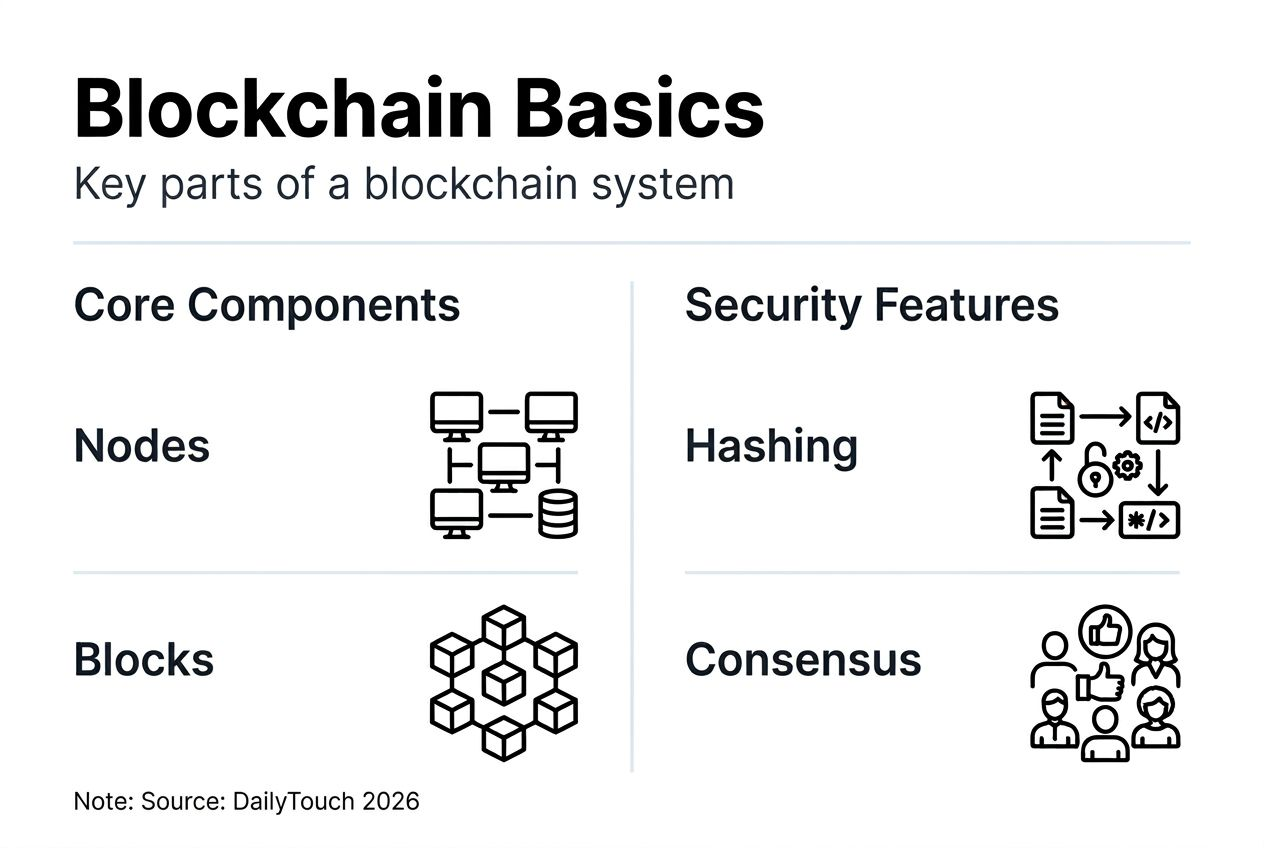
Consensus mechanisms are protocols that enable nodes to agree on transaction validity. The two most common approaches are Proof of Work and Proof of Stake, each with distinct characteristics:
| Feature | Proof of Work | Proof of Stake |
|---|---|---|
| Validation method | Solving complex mathematical puzzles | Staking cryptocurrency as collateral |
| Energy consumption | High (mining requires significant electricity) | Low (99% less than Proof of Work) |
| Transaction speed | Slower (10 minutes for Bitcoin blocks) | Faster (seconds to minutes) |
| Security approach | Computational power requirements | Economic incentives and penalties |
| Examples | Bitcoin, Ethereum Classic | Ethereum, Cardano, Solana |
Here’s how transaction validation works step by step:
- User initiates a transaction and broadcasts it to the network
- Nodes receive and verify the transaction meets protocol requirements
- Validated transactions get bundled into a new block
- Nodes compete to add the block using the consensus mechanism
- Winning node broadcasts the new block to all other nodes
- Network nodes verify and add the block to their ledger copies
- Transaction becomes permanent and irreversible
Modern blockchains have achieved significant scalability improvements. Contemporary blockchains can process thousands of transactions per second, addressing earlier performance limitations. Layer 2 solutions like Lightning Network and rollups further boost throughput while maintaining security.
Pro Tip: When evaluating blockchain platforms, check their consensus mechanism. Proof of Stake systems typically offer faster transactions and lower environmental impact, while Proof of Work provides battle tested security through computational requirements.
Emerging blockchain trends in 2026 include hybrid consensus models combining multiple approaches for optimal performance and security. These innovations make blockchain increasingly practical for enterprise applications requiring high transaction volumes.
Common misconceptions about blockchain
Blockchain technology suffers from widespread misunderstandings that create barriers to adoption. Clearing these myths helps people make informed decisions about blockchain applications.
Myth: Blockchain equals Bitcoin or cryptocurrency only
This is the most pervasive misconception. While Bitcoin introduced blockchain to the world, the technology extends far beyond digital currencies. Blockchain powers supply chain tracking, medical records, voting systems, digital identity, and blockchain gaming platforms. Limiting blockchain to crypto ignores its transformative potential across industries.
Myth: Blockchain guarantees complete anonymity
Blockchain transactions are pseudonymous, not anonymous. Public blockchains display all transaction details, though they show wallet addresses instead of names. Forensic analysis can often trace transactions back to individuals, especially when cryptocurrency converts to traditional currency. Privacy focused blockchains like Monero offer stronger anonymity, but most mainstream blockchains prioritize transparency over privacy.
Myth: Blockchain data is completely unchangeable
Immutability in blockchain means data alteration is difficult but not impossible. The Ethereum DAO hard fork in 2016 demonstrated how networks can reverse transactions through consensus. When the majority of nodes agree, blockchains can implement changes that alter historical records. True immutability exists only when network participants maintain consensus about preserving data.
“Hard forks represent rare but possible exceptions to blockchain immutability, occurring when the community reaches consensus about necessary changes to address critical issues or security vulnerabilities.”
Myth: Blockchain always wastes massive energy
Energy concerns mainly apply to Proof of Work; newer Proof of Stake blockchains reduce consumption by over 99%. Bitcoin’s energy intensive mining process created legitimate environmental worries. However, modern blockchains use efficient consensus mechanisms that require minimal electricity. Ethereum’s 2022 transition to Proof of Stake cut its energy use dramatically while maintaining security.
Key points to remember about blockchain myths:
- Blockchain serves countless industries beyond finance
- Transparency is a feature, not a privacy guarantee
- Immutability has practical exceptions through network consensus
- Consensus mechanism determines environmental impact
Pro Tip: Before dismissing blockchain based on outdated information, research current implementations. Technology has evolved significantly since Bitcoin’s early days, addressing many initial limitations through innovation.
Understanding these realities helps you evaluate blockchain projects accurately and recognize legitimate applications from overhyped promises.
Practical applications beyond cryptocurrency
Blockchain’s real world impact extends across industries, solving problems that require transparency, security, and traceability. Organizations worldwide leverage blockchain for tangible business benefits.
Supply chain management
Companies track products from manufacture to delivery, ensuring authenticity and reducing counterfeit goods. Walmart uses blockchain to trace food origins within seconds, enabling rapid response to contamination issues. This transparency builds consumer trust and protects brand reputation.
Healthcare
Medical facilities store patient records on blockchain, enabling secure sharing across providers while maintaining privacy. Patients control access to their health data, and doctors see complete medical histories instantly. This interoperability improves care quality and reduces duplicate testing.
Voting systems
Governments test blockchain for tamper proof elections where every vote gets recorded transparently and counted accurately. Voters can verify their ballots were recorded correctly without compromising anonymity. This technology addresses concerns about election integrity and accessibility.
Digital identity
Blockchain creates self sovereign identity systems where individuals control their personal information. Instead of multiple usernames and passwords, users maintain one verified digital identity across platforms. This reduces identity theft while simplifying authentication.
Education
Universities issue blockchain based diplomas and certificates that employers can verify instantly. Students own permanent, tamper proof credentials that follow them throughout their careers. This eliminates diploma fraud and streamlines credential verification.
| Industry | Blockchain Application | Example Organization | Key Benefit |
|---|---|---|---|
| Retail | Product authenticity tracking | Walmart, IBM Food Trust | Rapid contamination response |
| Healthcare | Patient record management | Mayo Clinic, Guardtime | Secure cross provider data sharing |
| Government | Land registry | Sweden, Ghana | Fraud prevention and transparency |
| Finance | Cross border payments | JPMorgan, Ripple | Faster settlements, lower fees |
| Logistics | Shipment tracking | Maersk, TradeLens | Real time visibility, reduced paperwork |
Explore more blockchain business use cases demonstrating how organizations unlock value through decentralized systems. These implementations show blockchain solving real problems rather than existing as theoretical technology.
Pro Tip: Industries with complex supply chains, multiple stakeholders, and high trust requirements gain the most immediate value from blockchain implementation. Start by identifying pain points related to transparency, verification, or intermediary costs.
The diversity of applications proves blockchain’s versatility beyond its cryptocurrency origins. As technology matures and costs decrease, expect broader adoption across sectors seeking secure, transparent operations.
Future and enterprise adoption
Enterprise blockchain adoption is accelerating as organizations recognize tangible returns on investment. The enterprise blockchain market is expected to reach $936 billion by 2030, driven by supply chain, digital identity, and tokenization solutions. This explosive growth reflects blockchain’s transition from experimental technology to business critical infrastructure.
Fortune 500 companies are implementing blockchain at scale:
- IBM operates Food Trust, tracking millions of food products across global supply chains
- Microsoft offers Azure Blockchain Services for enterprise application development
- Amazon provides managed blockchain solutions through AWS
- Walmart mandated blockchain tracking for leafy green suppliers after contamination outbreaks
Government agencies worldwide are deploying blockchain for public services. Estonia uses blockchain for healthcare records, judicial systems, and legislative processes. Dubai aims to become the first blockchain powered government by 2027, digitizing all transactions and documents.
The convergence of blockchain and artificial intelligence creates powerful synergies. AI algorithms analyze blockchain data for patterns and insights while blockchain provides tamper proof records of AI decisions. This combination enables transparent, accountable AI systems that users can trust.
Emerging blockchain trends reshaping businesses in 2026 include:
- Tokenization of real world assets: Converting property, art, and securities into blockchain tokens for fractional ownership
- Decentralized finance expansion: Traditional financial services rebuilt on blockchain infrastructure
- Central bank digital currencies: Government backed cryptocurrencies using blockchain technology
- Sustainability tracking: Carbon credit verification and environmental impact measurement
Blockchain’s role in building trusted digital ecosystems becomes increasingly critical as commerce and services move online. The technology provides verifiable truth in environments where trust traditionally required intermediaries. This capability makes blockchain foundational for why blockchain matters in 2026 and beyond.
“Enterprise blockchain market growth to $936 billion by 2030 represents a fundamental shift in how organizations approach data integrity, transparency, and stakeholder trust in digital operations.”
The blockchain market forecast indicates mainstream adoption accelerating through 2030. Organizations that understand and implement blockchain strategically will gain competitive advantages in efficiency, transparency, and customer trust. The technology’s maturation from experimental to essential infrastructure marks a pivotal moment in digital transformation.
Explore blockchain insights and solutions at DailyTouch
Now that you understand blockchain fundamentals, dive deeper into how this technology is reshaping industries and creating new opportunities. DailyTouch delivers expert analysis on why blockchain matters for trust and innovation, helping you stay ahead of critical developments.
Discover the latest developments in cryptocurrency markets, including recent news about crypto ETF filings featuring Bitcoin and Ethereum. Our comprehensive coverage connects blockchain technology with practical investment insights, regulatory updates, and market trends.
Whether you’re exploring blockchain for business applications or tracking cryptocurrency developments, DailyTouch provides clear, reliable information you can trust. Join thousands of readers who rely on our expert content to navigate the evolving blockchain landscape.
FAQ
What is the difference between blockchain and cryptocurrency?
Blockchain is the underlying technology that serves as a decentralized digital ledger. Cryptocurrency is one application built on blockchain, using it to record financial transactions securely without central banks. Think of blockchain as the internet infrastructure and cryptocurrency as one type of website running on it.
Can blockchain data be changed once recorded?
Blockchain data is extremely difficult to alter due to cryptographic links and distributed consensus requirements. However, changes can occur through network wide agreement, such as the Ethereum DAO hard fork in 2016 that reversed a major hack. These events are rare and require majority support from network participants.
What industries use blockchain besides finance?
Supply chain management uses blockchain for product tracking and authenticity verification. Healthcare implements blockchain for secure patient record sharing across providers. Government agencies deploy blockchain for voting systems, land registries, and digital identity solutions. Education, gaming, and energy sectors also leverage blockchain for transparency and security.
How does blockchain ensure security without central control?
Blockchain uses consensus mechanisms where multiple nodes must agree before adding transactions. Cryptographic hashing links blocks together, making tampering detectable immediately. The distributed nature means no single point of failure exists, and altering records would require controlling the majority of network nodes simultaneously, which is economically impractical.
What is the environmental impact of blockchain technology?
Environmental impact varies dramatically by consensus mechanism. Proof of Work blockchains like Bitcoin consume significant energy for mining operations. Proof of Stake systems use over 99% less energy by eliminating computational mining requirements. Modern blockchain implementations prioritize energy efficiency while maintaining security and decentralization.