



Most people think blockchain is just a faster way to send money. The reality is more radical: blockchain dismantles the entire intermediary layer that traditional finance depends on for custody, settlement, and authentication. In 2026, this fundamental architectural difference reshapes how markets operate, who can access them, and how regulators enforce compliance. Understanding these distinctions helps investors, financial professionals, and tech enthusiasts navigate a rapidly evolving landscape where decentralized systems challenge centuries-old institutional frameworks.
Table of Contents
- Understanding Traditional Finance: Structure, Role, And Challenges
- How Blockchain And Defi Reshape Financial Services
- Regulatory Challenges And Evolving Security Mechanisms
- Practical Applications: Efficiency, Tokenization, And Market Transparency
- Explore Blockchain Innovations With Dailytouch
Key takeaways
| Point | Details |
|---|---|
| Institutional structure | Traditional finance relies on intermediaries while blockchain enables direct, permissionless peer-to-peer transactions. |
| Transparency and access | Blockchain delivers real-time data visibility and lowers entry barriers, but introduces smart contract and infrastructure risks. |
| Regulatory adaptation | Self-custody removes enforcement points, requiring adaptive frameworks and privacy-preserving technologies like zero-knowledge proofs. |
| Operational efficiency | Distributed ledger technology eliminates reconciliation delays, enabling real-time settlements and fractional asset ownership through tokenization. |
| Market metrics | DeFi introduces new measurement standards like total value locked that differ fundamentally from traditional asset valuation methods. |
Understanding traditional finance: structure, role, and challenges
Traditional financial markets depend on a layered network of intermediaries. Banks, clearinghouses, and custodians perform essential functions including custody management, transaction authentication, settlement processing, and regulatory compliance enforcement. In traditional markets, intermediaries provide custody, authentication, settlement, and regulatory compliance, creating a system where trust flows through institutional gatekeepers rather than cryptographic verification.
This intermediated architecture introduces operational friction. Traditional trade settlement processes involve multiple entities maintaining separate ledgers, requiring T+2 or T+3 settlement windows to reconcile discrepancies across fragmented databases. Each intermediary maintains its own records, creating opportunities for errors, delays, and inefficiencies that compound across the transaction lifecycle.
Several challenges emerge from this structure:
- Multiple ledgers require constant reconciliation, consuming resources and increasing operational costs
- Settlement delays lock capital and create counterparty risk during the clearing window
- Transparency remains limited, with financial data often delayed or accessible only to authorized parties
- Entry barriers restrict market participation to entities meeting institutional requirements
- Manual processes introduce human error and slow down transaction finality
Regulatory frameworks evolved alongside these intermediaries. Compliance depends on financial institutions acting as enforcement points, monitoring transactions, reporting suspicious activity, and maintaining customer records. This approach works when identifiable entities control access points, but struggles when decentralized systems remove intermediaries from the equation entirely.
How blockchain and DeFi reshape financial services
Blockchain technology fundamentally restructures financial market architecture by replacing intermediaries with cryptographic protocols. Users maintain direct custody of assets through private keys, eliminating the need for banks or custodians to hold funds on their behalf. This shift from intermediated to self-custody models transforms how markets operate, who can participate, and what risks emerge.

DeFi’s openness reduces entry barriers, improves transparency and access, and fosters competition by enabling anyone with internet access to interact with financial protocols. Traditional gatekeepers no longer determine who qualifies for market participation. Smart contracts execute transactions automatically when predetermined conditions are met, removing discretionary approval processes and reducing transaction costs.
Transparency reaches unprecedented levels in blockchain finance. DeFi protocols offer financial data in real-time, updating relevant data daily, sometimes hourly, providing greater market visibility than traditional systems where reporting lags weeks or months behind actual transactions. Every transaction writes to an immutable public ledger, allowing participants to verify positions, collateral ratios, and protocol health independently.
This openness creates competitive advantages:
- Market efficiency improves as information asymmetries decrease and price discovery accelerates
- Innovation accelerates when developers can build on existing protocols without permission
- Competition intensifies as barriers protecting incumbent institutions disappear
- Capital flows more freely across borders without correspondent banking networks
Yet new risks accompany these benefits. Smart contract vulnerabilities can drain entire protocols if code contains exploitable flaws. Infrastructure concentration emerges when most DeFi activity channels through a handful of blockchain networks, creating systemic dependencies. Oracle manipulation threatens protocols relying on external data feeds for pricing and settlement.
Pro Tip: Monitor DeFi metrics like total value locked alongside traditional trade volumes to understand market health comprehensively. TVL reveals actual capital committed to protocols, providing early signals of confidence shifts before they appear in price movements.
Regulatory challenges and evolving security mechanisms
Traditional regulatory frameworks assume identifiable intermediaries serve as enforcement points. Regulators mandate banks to verify customer identities, monitor transactions for suspicious activity, and maintain records accessible for investigation. Because self-custody removes intermediaries as enforcement points, regulation cannot simply extend existing frameworks to decentralized systems where no central party controls user access or transaction flows.
This creates fundamental tensions. Blockchain users value financial privacy and self-sovereignty, resisting surveillance mechanisms embedded in traditional finance. Yet regulators require tools to prevent money laundering, terrorist financing, and tax evasion. Reconciling these competing demands drives innovation in privacy-preserving compliance technologies.
Zero-knowledge proofs have strong potential for protecting clients, assets, and transaction data while still enabling regulatory verification. These cryptographic techniques allow one party to prove statement validity without revealing underlying data. A user could demonstrate sufficient funds for a transaction without disclosing their complete balance or transaction history.
Several regulatory approaches emerge in 2026:
- Adaptive frameworks focus on protocol outcomes rather than intermediary obligations
- Privacy-preserving disclosure mechanisms balance transparency with confidentiality
- Integration pathways connect blockchain systems to traditional reporting infrastructure
- Risk-based approaches calibrate oversight intensity to protocol characteristics
Compliance challenges persist despite these innovations. Decentralized autonomous organizations lack legal personalities, complicating liability assignment when protocols fail. Cross-border transactions occur instantly on blockchains, but regulatory authority remains territorially bound. Pseudonymous addressing provides some privacy but complicates sanctions enforcement and asset recovery.
Security mechanisms evolve beyond traditional perimeter defenses. Multi-signature wallets require multiple key holders to authorize transactions, distributing custody risk. Time-locked contracts prevent immediate withdrawals after deposits, giving protocols time to detect suspicious activity before funds leave. Formal verification mathematically proves smart contract behavior matches intended specifications, catching bugs before deployment.
Pro Tip: Stay current on evolving regulatory guidance and security protocols through specialized blockchain compliance resources. Regulations shift rapidly as governments experiment with oversight approaches, and yesterday’s compliant structure may face challenges tomorrow.
Practical applications: efficiency, tokenization, and market transparency
Blockchain delivers concrete operational improvements over traditional financial infrastructure. Distributed ledger technology offers a unified, tamper-resistant ledger accessible in real time to authorized participants, eliminating the fragmented databases that create reconciliation burdens in conventional systems. All parties view the same transaction record simultaneously, removing discrepancies that delay settlements and consume operational resources.
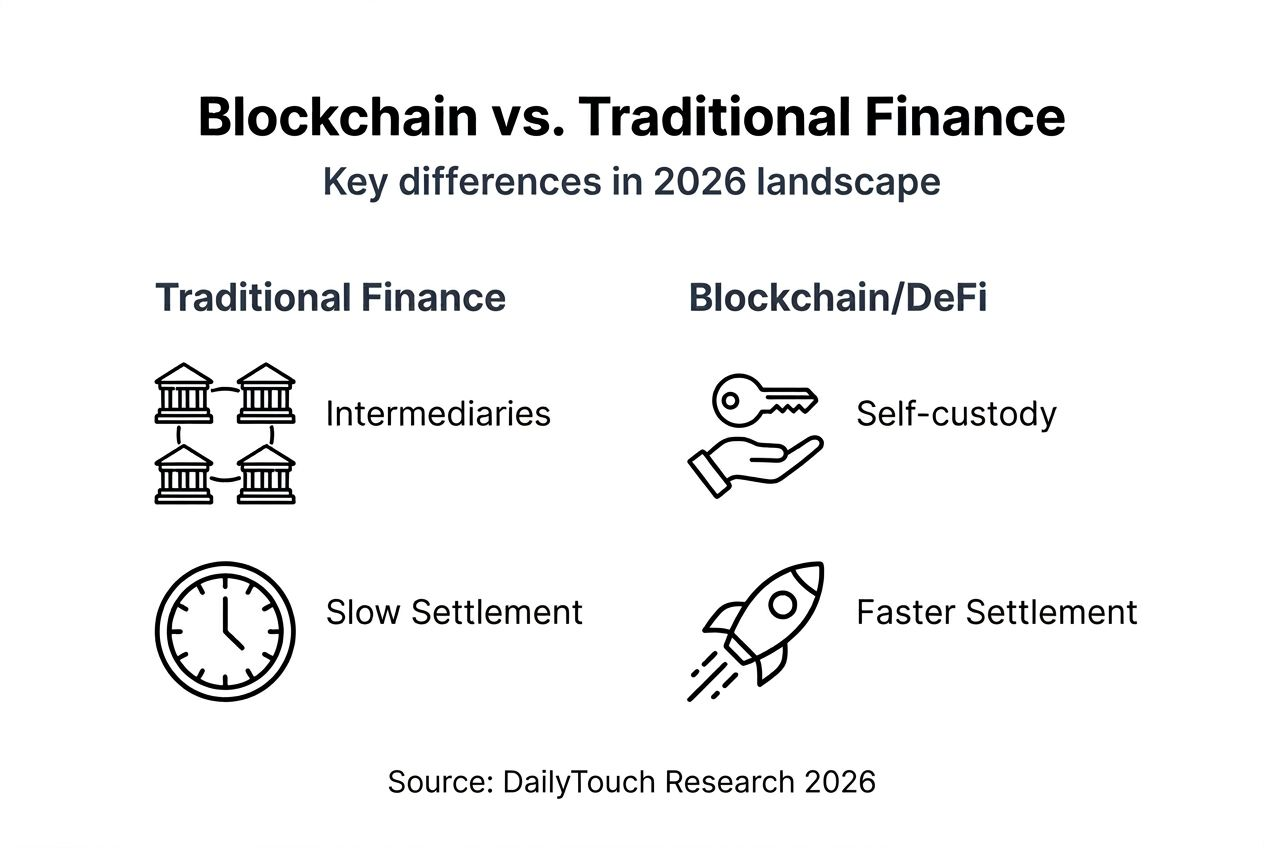
Settlement latency drops dramatically. Traditional securities trades require two or three business days to finalize as clearinghouses coordinate between buyer and seller banks, verify account balances, and update multiple ledgers. Blockchain enables near-instantaneous settlement where asset transfer and payment occur atomically in a single transaction. Capital previously locked during settlement windows becomes immediately available for redeployment.
Tokenization enables fractional ownership, enhances liquidity, and automates asset lifecycle management through smart contracts that execute predefined rules without manual intervention. A commercial property worth millions can be divided into thousands of tokens, each representing fractional ownership. Investors buy portions matching their capital, while smart contracts automatically distribute rental income proportionally and enforce transfer restrictions.
Key advantages emerge:
- Real-time settlement reduces counterparty risk and capital requirements
- Fractional ownership democratizes access to previously illiquid asset classes
- Automated lifecycle management eliminates manual corporate actions processing
- Transparent audit trails simplify compliance verification and reporting
- Programmable assets enable complex financial structures without intermediary coordination
| Feature | Traditional Finance | Blockchain Finance |
|---|---|---|
| Settlement speed | T+2 to T+3 days | Near-instantaneous |
| Ownership | Whole units typically required | Fractional ownership enabled |
| Transparency | Delayed, intermediated reporting | Real-time, immutable ledger |
| Lifecycle management | Manual processing via intermediaries | Automated smart contract execution |
| Reconciliation | Required across multiple ledgers | Single shared ledger eliminates need |
Liquidity improvements extend beyond faster settlements. Global market access means assets trade continuously across time zones without exchange hour restrictions. Secondary markets emerge for previously illiquid assets when tokenization lowers transaction costs and divisibility barriers. Price discovery improves as transparent order books reveal supply and demand in real time rather than through periodic published quotes.
Market transparency transforms risk assessment. Traditional finance obscures positions and leverage until quarterly filings or regulatory reports surface weeks after period end. Blockchain exposes protocol reserves, collateral ratios, and outstanding obligations continuously, allowing market participants to monitor systemic risk indicators independently. When a DeFi protocol approaches insolvency, users can observe declining collateral coverage immediately rather than discovering problems through delayed announcements.
Explore blockchain innovations with DailyTouch
Understanding how blockchain transforms financial markets positions you to navigate emerging opportunities and risks in 2026. DailyTouch delivers current insights on blockchain’s expanding role across traditional and decentralized finance, helping you stay ahead of market developments and regulatory shifts reshaping the industry.
Discover how blockchain unlocks multi-trillion dollar markets through tokenization and distributed ledger efficiency. Explore integration strategies businesses adopt to capture operational advantages and competitive positioning. Track developments in crypto ETFs and institutional adoption signaling mainstream acceptance. DailyTouch provides the context and analysis you need to make informed decisions as blockchain and traditional finance continue converging and competing.
FAQ
What is the main difference between blockchain finance and traditional finance?
Blockchain finance operates through decentralized, permissionless networks where users control assets directly via private keys, eliminating intermediaries like banks and clearinghouses. Traditional finance routes transactions through centralized institutions that provide custody, authentication, and settlement services. This structural difference fundamentally changes market access, transparency, operational processes, and regulatory approaches.
How does blockchain improve transparency compared to traditional markets?
Blockchain records every transaction on an immutable public ledger accessible to all participants in real time, enabling independent verification of positions, reserves, and protocol health. Traditional markets rely on delayed periodic reporting filtered through intermediaries, creating information asymmetries where complete data arrives weeks or months after transactions occur. This transparency gap affects risk assessment, price discovery, and market efficiency.
What are the key regulatory challenges with blockchain-based finance?
Traditional regulations depend on intermediaries serving as enforcement points for identity verification, transaction monitoring, and compliance reporting. Blockchain’s self-custody model removes these gatekeepers, requiring entirely new regulatory frameworks that balance privacy rights with oversight needs. Adaptive approaches using privacy-preserving technologies like zero-knowledge proofs attempt to verify compliance without exposing sensitive transaction details or compromising user autonomy.
Can blockchain technology reduce settlement times and costs?
Blockchain’s shared ledger architecture enables near-instantaneous settlement by eliminating multiple intermediary ledgers requiring reconciliation across institutions. Traditional T+2 or T+3 settlement windows disappear when asset transfer and payment occur atomically in single transactions. This reduces counterparty risk, frees locked capital for immediate redeployment, and eliminates operational costs associated with manual reconciliation processes across fragmented databases.