



Blockchain’s impact extends far beyond cryptocurrency headlines. In 2025, stablecoin transaction volume reached $10.66 trillion, demonstrating real utility in programmable payments and financial infrastructure. As regulatory clarity emerges across major economies in 2026, blockchain technology is transforming how institutions manage trust, tokenize assets, and execute transparent operations. This article explores blockchain’s foundational principles, regulatory developments, financial market impacts, enterprise adoption, and persistent misconceptions that limit its broader understanding.
Table of Contents
- Introduction To Blockchain Technology And Why It Matters
- Regulatory Clarity And Its Role In Blockchain Adoption
- Blockchain’s Impact On Financial Markets
- Enterprise Blockchain Adoption And Industry Impact
- Tokenization And New Economic Models Enabled By Blockchain
- Common Misconceptions About Blockchain
- Challenges In Blockchain Infrastructure And Scaling
- Blockchain Innovation And Technological Synergies
- Conclusion: Why Blockchain Matters For The Future Of Markets And Innovation
- Explore Blockchain Insights And Investment Opportunities With DailyTouch
Key takeaways
| Point | Details |
|---|---|
| Blockchain enables decentralized trust and transparency | Distributed ledger technology removes intermediaries through immutable, transparent record keeping across networks. |
| Regulatory clarity in 2025-2026 accelerates adoption | MiCA, GENIUS Act, and stablecoin frameworks reduce uncertainty, boosting institutional confidence globally. |
| Tokenization transforms financial markets | Real-world asset tokenization reached $18.6 billion, enabling fractional ownership and faster settlements. |
| Enterprises use blockchain for efficiency and compliance | Private blockchains drive operational gains in finance, healthcare, and supply chain with projected $287.8B market by 2032. |
| Misconceptions limit understanding of blockchain’s potential | Beyond crypto speculation, blockchain supports digital identity, public records, and transparent auditing across industries. |
Introduction to blockchain technology and why it matters
Blockchain is a distributed ledger technology that records transactions across multiple computers, creating a decentralized system where no single entity controls the data. Unlike traditional centralized models where banks or corporations maintain exclusive databases, blockchain distributes trust across network participants. Growing global interest in blockchain innovation in 2026 reflects this shift toward transparent, verifiable systems.
Key blockchain features include:
- Immutability: Once recorded, data cannot be altered without network consensus, preventing fraud
- Transparency: All participants can verify transactions, reducing disputes and audit costs
- Security: Cryptographic protection makes unauthorized changes computationally impractical
- Decentralization: No single point of failure or control, distributing power among users
Institutional interest surged as regulatory frameworks matured through 2025 and early 2026. Major financial institutions now explore why use blockchain 2026 unlock 16t asset market opportunities, moving beyond speculative cryptocurrency trading toward operational applications. The technology underpins blockchain trends businesses 2026 integration efficiency strategies across sectors.
Think of blockchain as a shared digital notebook where every page is photocopied to thousands of locations simultaneously. Any attempt to change one copy becomes immediately obvious when compared against all others. This creates trust without requiring a central authority.
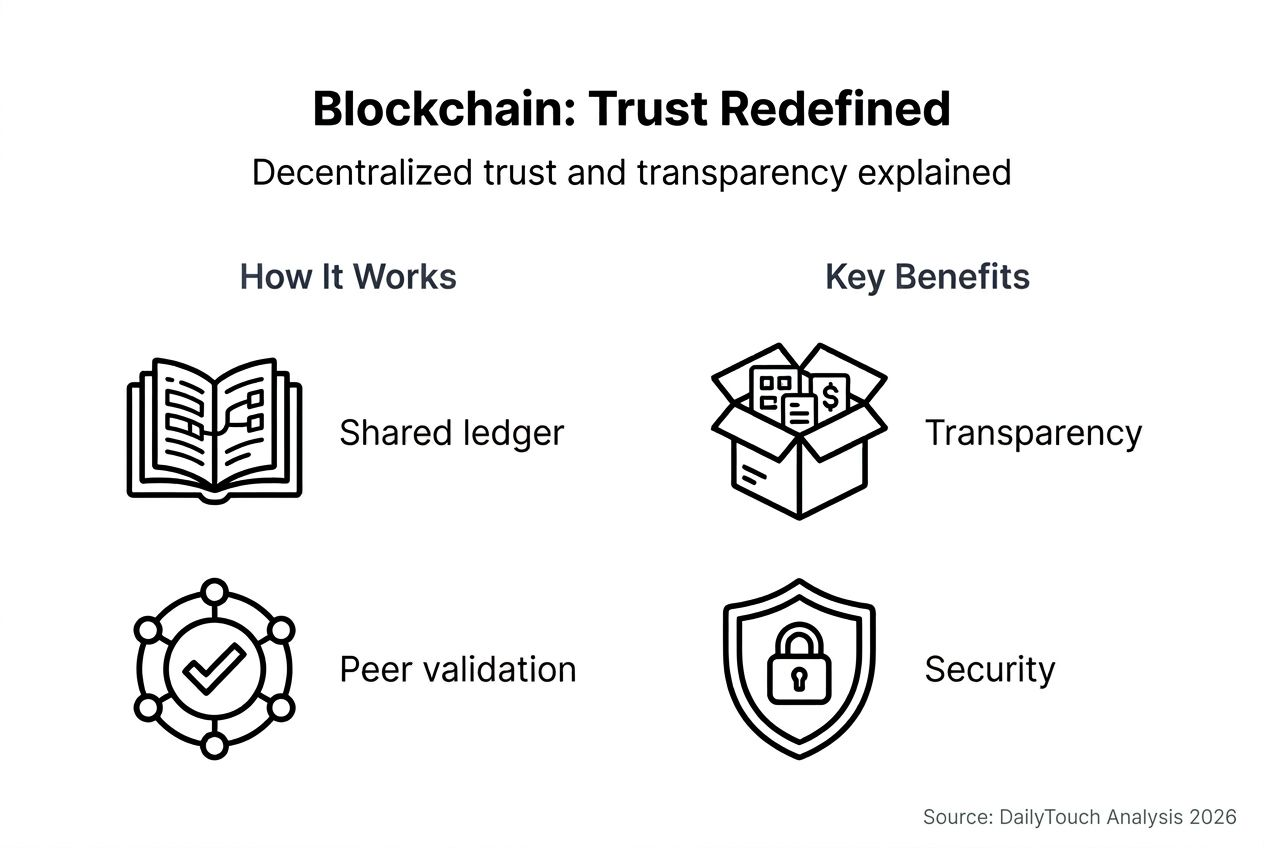
The foundational mental model: Decentralized Trust and Token Economy Framework. Blockchain replaces institutional trust with algorithmic verification, while tokenization converts physical or financial assets into programmable digital units. This combination enables new economic models where assets become liquid, divisible, and globally tradable. Understanding harness blockchain network effects growth 2026 requires grasping this dual mechanism.
Investors exploring best cryptocurrencies to invest in 2026 should recognize that underlying blockchain infrastructure determines long-term value more than token speculation. Projects like ethereum 2029 roadmap high speed internet value demonstrate how technical architecture shapes adoption trajectories.
Regulatory clarity and its role in blockchain adoption
After understanding blockchain basics, recognizing how regulation enables institutional adoption becomes critical. Throughout 2025 and into 2026, major jurisdictions established frameworks that transformed blockchain from experimental technology into compliant infrastructure.
In 2025, regulatory clarity across major jurisdictions significantly advanced blockchain adoption, creating predictable legal environments for enterprises and investors. Key developments include:
- MiCA (Markets in Crypto-Assets): EU regulation providing comprehensive oversight for crypto service providers, establishing consumer protections and operational standards
- GENIUS Act: US legislation clarifying tax treatment and regulatory authority, reducing compliance uncertainty for American businesses
- Stablecoin frameworks: Guidelines ensuring reserve transparency and redemption rights, critical for payment infrastructure
- Cross-border cooperation: Harmonization efforts between regulators reducing compliance fragmentation
Regulatory certainty builds institutional investor confidence by defining legal boundaries and operational requirements. Banks, asset managers, and corporations previously hesitant due to legal ambiguity now deploy blockchain solutions within clear compliance parameters. This shift explains accelerated enterprise adoption rates observed through late 2025.
Unified compliance frameworks foster cross-jurisdiction cooperation, allowing multinational enterprises to implement consistent blockchain strategies rather than navigating contradictory regional rules. Financial services firms particularly benefit from standardized know-your-customer and anti-money-laundering protocols embedded in blockchain systems.
Increased enterprise deployments follow directly from clear rules. Companies launch tokenization platforms, supply chain tracking, and programmable payment systems knowing regulatory boundaries. Healthcare organizations implement patient data systems, while manufacturers deploy transparent sourcing verification, all enabled by predictable legal frameworks.
Long-term blockchain growth depends on sustainable regulation balancing innovation with consumer protection. Over-regulation stifles experimentation, while under-regulation invites fraud and instability. The 2025-2026 regulatory maturation represents a middle path, establishing baseline standards while allowing technological evolution. Bitcoin price prediction 2026 expert forecast analyses increasingly incorporate regulatory developments as fundamental price drivers alongside technical factors.
Blockchain’s impact on financial markets
Transitioning from regulatory frameworks to practical impacts, blockchain technology fundamentally reshapes financial infrastructure through programmable money, tokenized assets, and transparent settlement systems.
Stablecoins function as programmable payment rails, combining fiat currency stability with blockchain speed and transparency. $10.66 trillion stablecoin transaction volume in 2025 demonstrates blockchain utility far exceeding speculative cryptocurrency trading. Businesses use stablecoins for cross-border payments, treasury management, and smart contract execution, accessing 24/7 settlement without traditional banking delays.
| Feature | Stablecoins | CBDCs | Traditional Currency |
|---|---|---|---|
| Settlement Speed | Minutes | Hours | 2-5 days |
| Operating Hours | 24/7/365 | Limited | Business hours |
| Transparency | Full blockchain audit trail | Partial | Opaque intermediaries |
| Programmability | Smart contract enabled | Varies by design | Manual processes |
| Cross-border Cost | Low (network fees) | Medium | High (correspondent banking) |
Tokenization reached $18.6 billion in real-world assets by late 2025, with major asset managers launching regulated products. This innovation converts traditionally illiquid assets like private credit, real estate, and bonds into divisible digital tokens tradable on blockchain platforms. Fractional ownership unlocks capital previously inaccessible to smaller investors.
Financial benefits include:
- Enhanced liquidity: 24/7 secondary markets for traditionally illiquid assets
- Radical transparency: Blockchain audit trails reduce settlement disputes and operational errors
- Faster settlements: Smart contracts automate clearing and settlement, compressing timelines from days to minutes
- Lower costs: Removing intermediaries reduces transaction fees and administrative overhead
- Global access: Borderless platforms enable international participation in local markets
Pro Tip: When evaluating tokenized products, verify regulatory compliance, custodian reputation, and liquidity provisions. Credible platforms provide clear documentation of asset backing, redemption mechanisms, and legal structures. Avoid projects lacking transparent reserve audits or regulatory registration.
Understanding unlock blockchain asset market 2026 opportunities requires recognizing tokenization as infrastructure innovation, not speculative trading. Investors should explore crypto token key facts to distinguish utility tokens from securities and payment mechanisms.
Enterprise blockchain adoption and industry impact
Expanding from financial markets, enterprises across sectors leverage blockchain for competitive advantages, compliance efficiencies, and operational transparency.
Leading sectors include finance for regulatory compliance and audit trails, healthcare for secure patient data exchange, and supply chain for end-to-end traceability. Enterprise blockchain market projected to grow to $287.8 billion by 2032, driven by healthcare and finance adoption, reflects broad industry recognition of blockchain’s operational value.

Private and permissioned blockchains address enterprise needs for controlled access while maintaining blockchain benefits. Unlike public blockchains where anyone can participate, permissioned systems restrict validation rights to authorized entities. This design satisfies compliance requirements around data privacy, access controls, and regulatory reporting while preserving immutability and transparency among permitted participants.
Walmart’s supply chain implementation demonstrates practical impact:
“Blockchain reduced investigation time for food contamination from weeks to seconds, enabling precise recalls affecting only contaminated batches rather than entire product lines. This saves millions in waste while protecting consumer safety through transparent tracking from farm to store.”
Enterprise benefits include:
- Operational efficiency: Automated verification reduces manual reconciliation and administrative overhead
- Enhanced auditability: Immutable records simplify compliance reporting and regulatory examinations
- Fraud reduction: Transparent provenance tracking prevents counterfeit products and falsified documentation
- Interoperability: Standardized blockchain protocols enable seamless data sharing across organizational boundaries
- Cost savings: Streamlined processes and reduced intermediaries lower operational expenses
Projected market growth reflects ongoing corporate investments in blockchain infrastructure, pilot programs transitioning to production deployments, and consultancies building enterprise-grade solutions. Financial institutions implement blockchain for trade finance, healthcare organizations deploy clinical data exchanges, and manufacturers track component provenance through distributed supply networks.
Businesses exploring blockchain adoption benefits roi settlements 2026 should focus on specific operational pain points rather than implementing blockchain for technology’s sake. Successful deployments solve concrete problems like settlement delays, audit inefficiencies, or supply chain opacity.
Tokenization and new economic models enabled by blockchain
Building on blockchain financial uses, tokenization emerges as a transformative innovation enabling new economic efficiencies and asset accessibility.
Tokenization converts ownership rights of physical or financial assets into digital tokens on blockchain networks, fundamentally different from traditional asset management where ownership records reside in centralized databases controlled by intermediaries. Tokenization of real-world assets reached $18.6 billion with major asset managers launching regulated products throughout 2025 and early 2026.
| Feature | Tokenization | Traditional Methods |
|---|---|---|
| Settlement Time | Minutes to hours | 2-5 business days |
| Fractional Ownership | Easily divisible to small units | Minimum investment thresholds |
| Trading Hours | 24/7 global markets | Limited exchange hours |
| Geographic Access | Borderless participation | Jurisdiction restrictions |
| Intermediary Costs | Reduced via smart contracts | Multiple fee layers |
| Transparency | Blockchain audit trail | Opaque custody chains |
How tokenization reduces settlement times and costs:
- Asset representation: Physical or financial asset converted to digital token on blockchain with ownership rights encoded in smart contract
- Automated verification: Smart contracts automatically verify transaction conditions, eliminating manual clearing processes
- Instant settlement: Blockchain transfer executes immediately upon condition satisfaction, removing multi-day custody transfers
- Reduced intermediaries: Direct peer-to-peer transfers eliminate custodian banks, clearinghouses, and settlement agents
- Lower operational overhead: Automated processes reduce administrative staff, reconciliation costs, and error correction expenses
Economic impacts span private credit markets where tokenization enables fractional participation in debt instruments, bond markets with programmable coupon payments and automated compliance, and real assets like real estate or artwork becoming accessible to smaller investors through fractional ownership.
Institutional launches of regulated tokenized products by BlackRock, Franklin Templeton, and other major asset managers signal mainstream acceptance. These offerings provide investors with blockchain efficiency benefits while maintaining regulatory compliance and institutional-grade custody.
Investors should explore blockchain asset market unlock 2026 opportunities while understanding crypto token investor facts distinguishing securities tokens from utility or payment tokens. Regulatory classification determines investor protections and tax treatment.
Common misconceptions about blockchain
After explaining blockchain’s market uses, addressing prevalent myths becomes essential for accurate understanding of this technology’s breadth.
Blockchain extends far beyond cryptocurrencies into supply chains tracking product provenance from manufacture to delivery, digital identity systems providing verifiable credentials without centralized databases, and public records like property titles or academic certifications maintained transparently and immutably.
Private and permissioned blockchains serve enterprise compliance needs by restricting network access to authorized participants while maintaining blockchain’s core benefits. Banks use private blockchains for interbank settlements, healthcare organizations deploy permissioned networks for patient data exchange respecting privacy regulations, and manufacturers implement controlled supply chain tracking.
Top misconceptions with factual corrections:
- “Blockchain equals cryptocurrency speculation”: Blockchain is infrastructure technology supporting diverse applications; cryptocurrencies represent one use case among many
- “Blockchain cannot scale for enterprise use”: Modern blockchain architectures handle thousands of transactions per second with optimized consensus mechanisms
- “All blockchain data is public”: Private blockchains restrict visibility to authorized participants, satisfying enterprise privacy requirements
- “Blockchain eliminates all intermediaries”: Blockchain reduces unnecessary intermediaries but often requires validators, oracles, and custodians for specific functions
- “Blockchain technology is too complex for traditional businesses”: Abstraction layers and enterprise platforms simplify blockchain integration without requiring deep technical expertise
Pro Tip: When evaluating blockchain news, distinguish between speculative cryptocurrency price movements and substantive technological deployments. Look for specific use cases, regulatory compliance, and measurable operational improvements rather than generic hype or price predictions.
39%+ healthcare organizations already use blockchain for clinical data exchange and fraud prevention, demonstrating significant adoption beyond financial speculation. This healthcare sector embrace reflects blockchain’s practical value for secure data sharing under strict privacy regulations.
Understanding blockchain gaming market overview shows entertainment applications, while crypto token investor facts clarifies technical distinctions often confused in popular discourse.
Challenges in blockchain infrastructure and scaling
Balancing the narrative requires acknowledging technological and operational hurdles confronting blockchain as it integrates with traditional systems at enterprise scale.
Operational gaps limiting blockchain scalability include insufficient transaction throughput for high-volume applications, latency issues conflicting with real-time processing requirements, and energy consumption concerns for proof-of-work consensus mechanisms. Blockchain adoption faces challenges combining traditional risk management with crypto execution speed, requiring new institutional infrastructure bridging both worlds.
Key challenges include:
- Risk management integration: Enterprise systems require robust controls, audit trails, and rollback capabilities often absent in early blockchain designs
- Infrastructure maturity: Production-grade blockchain platforms need 99.9%+ uptime, disaster recovery, and regulatory compliance certifications
- Interoperability: Different blockchain networks struggle to communicate, creating fragmented ecosystems and limiting network effects
- Talent shortage: Limited blockchain developers and architects slow enterprise deployment timelines
- Legacy system integration: Connecting blockchain to existing databases, APIs, and workflows presents technical complexity
Institutional demand drives platform innovation as banks, asset managers, and corporations require blockchain solutions meeting enterprise standards for security, compliance, and operational reliability. This pressure accelerates development of hybrid systems combining blockchain benefits with traditional risk controls.
Proven platforms blending speed and compliance become critical adoption enablers. Enterprises seek solutions offering blockchain efficiency without sacrificing regulatory reporting, access controls, and audit capabilities. Platforms providing permissioned networks, integrated compliance tools, and institutional custody address these requirements.
Approaches for overcoming barriers include layer-2 scaling solutions increasing throughput without sacrificing decentralization, cross-chain bridges enabling interoperability between networks, and hybrid architectures combining public blockchain security with private network performance. Regulatory sandboxes allow controlled experimentation, while industry consortia develop shared standards reducing fragmentation.
Businesses should explore blockchain adoption benefits 2026 while realistically assessing implementation complexity and required infrastructure investments.
Blockchain innovation and technological synergies
Following infrastructure challenges, ongoing innovation demonstrates how complementary technologies enhance blockchain capabilities and accelerate adoption.
AI and machine learning integration with blockchain dramatically improves fraud detection by analyzing transaction patterns across immutable ledgers. AI-driven fraud detection improved rates from less than 1% to 25% leveraging blockchain data, showcasing synergies between algorithmic analysis and transparent record-keeping.
Examples of impacts on auditability and operational efficiency include automated anomaly detection flagging suspicious transactions in real-time, predictive models identifying high-risk counterparties before contract execution, and natural language processing extracting insights from smart contract code and blockchain audit trails.
Expert perspective highlights technological convergence:
“The combination of blockchain’s transparent, immutable data with AI’s pattern recognition creates unprecedented capabilities for automated compliance, risk assessment, and operational optimization. Organizations deploying both technologies together achieve competitive advantages impossible with either alone.”
Other emerging tech areas complementing blockchain include:
- Internet of Things (IoT): Connected devices record verifiable data directly to blockchains, enabling automated supply chain tracking and smart city infrastructure
- Quantum-resistant cryptography: Next-generation encryption protects blockchain networks against future quantum computing threats
- Zero-knowledge proofs: Advanced cryptography enabling private transactions on public blockchains, balancing transparency with confidentiality
- Edge computing: Distributed processing reduces blockchain latency and enables real-time applications
Blockchain serves as foundational infrastructure for the evolving digital economy, providing trust layers upon which other technologies build. As 5G enables faster connectivity, IoT generates verifiable data streams, and AI optimizes decision-making, blockchain ensures transparent, tamper-resistant record-keeping underlying these systems.
Organizations should harness blockchain network effects growth 2026 by integrating complementary technologies rather than viewing blockchain in isolation.
Conclusion: why blockchain matters for the future of markets and innovation
Blockchain technology transforms how institutions, markets, and individuals establish trust and execute transparent operations. Its core impact centers on decentralized trust mechanisms replacing intermediaries with algorithmic verification and token economies enabling programmable assets and new economic models.
Regulatory advances through 2025 and 2026 provide clear frameworks accelerating mainstream adoption, while technological innovations address scalability and integration challenges. Financial markets embrace tokenization for liquidity and efficiency gains, enterprises deploy blockchain for operational advantages and compliance simplification, and cross-industry applications extend far beyond cryptocurrency speculation.
Broad industry applications demonstrate blockchain’s versatility, from healthcare patient data exchange to supply chain provenance tracking and digital identity systems. As infrastructure matures and regulatory clarity deepens, blockchain becomes essential infrastructure for digital economy evolution.
Embrace informed understanding by evaluating blockchain opportunities based on specific use cases, regulatory compliance, and measurable operational improvements. Move beyond hype to assess concrete value propositions, technological readiness, and implementation pathways. The blockchain revolution unfolds through practical deployments solving real problems, not speculative narratives or generic promises.
Explore blockchain insights and investment opportunities with DailyTouch
Staying informed about blockchain developments requires reliable sources delivering timely market intelligence and regulatory updates. DailyTouch provides comprehensive coverage of blockchain trends, tokenization advances, and institutional adoption patterns shaping 2026 markets.
Our in-depth analysis explores crypto token investor facts distinguishing utility from securities tokens, while tracking blockchain trends businesses 2026 integration efficiency strategies across industries. Access latest developments including trump media crypto ETF filing and other institutional moves signaling mainstream blockchain acceptance. DailyTouch delivers actionable insights helping investors and business leaders navigate blockchain’s expanding market opportunities with clarity and confidence.
FAQ
What is blockchain technology in simple terms?
Blockchain is a secure digital ledger recording transactions across many computers, ensuring transparency and reducing intermediary needs. It enables decentralized trust by making data tamper-resistant and shared among participants, creating verifiable records without central authority control.
How do recent regulations affect blockchain adoption?
Regulations like MiCA and the GENIUS Act provide clear legal frameworks, increasing trust and reducing risks for investors and businesses. Regulatory clarity accelerated blockchain integration in finance and enterprise sectors worldwide throughout 2025 and into 2026.
What are common misconceptions about blockchain?
Blockchain is often mistaken as only related to cryptocurrencies, but it supports supply chains, digital identity, and public records across diverse industries. Many believe blockchain cannot serve enterprises, though private blockchains are widely adopted for compliance and operational efficiency.
How does tokenization transform traditional finance?
Tokenization digitizes assets enabling fractional ownership, faster settlements, and lower transaction costs through smart contract automation. It creates new economic models by making traditionally illiquid assets more liquid and accessible to smaller investors globally.
What challenges does blockchain face today?
Challenges include integrating blockchain speed with traditional risk controls and building scalable infrastructure meeting enterprise reliability standards. Institutions seek proven platforms balancing compliance, security, and performance to overcome these technical and operational barriers.