



Bitcoin’s scripting language has long been considered restrictive compared to Ethereum’s flexible smart contracts, limiting its use to basic transactions. Recent breakthroughs in 2026 are challenging this perception by enabling programmable covenants on Bitcoin without altering its core protocol. Innovations like PIPEs v2, OptiBridge, BABE, and BitVM3 are transforming how developers build on Bitcoin, reducing costs and expanding capabilities. These advances open doors to trustless vaults, zkRollups, and efficient cross-chain bridges, positioning Bitcoin as a platform for sophisticated decentralized applications. Understanding these technical leaps is essential for professionals navigating the evolving blockchain landscape.
Table of Contents
- How Pipes V2 Unlocks Advanced Programmability On Bitcoin
- Optibridge: Efficient And Secure Blockchain Bridging
- Babe And Bitvm3: Cutting Costs And Complexity In Blockchain Proofs
- Implications Of 2026 Blockchain Innovations For Tech Enthusiasts And Professionals
- Explore More Blockchain Insights And Market Analysis
Key takeaways
| Point | Details |
|---|---|
| PIPEs v2 enables covenants | Programmable spending conditions on Bitcoin without soft forks or trusted setups |
| OptiBridge cuts bridging costs | Optimistic deployment reduces gas fees by approximately 73% compared to Alba protocol |
| BABE reduces storage needs | Off-chain storage and setup costs drop by three orders of magnitude versus BitVM3 |
| BitVM3 lowers transaction fees | On-chain costs decrease significantly by moving verification off-chain using garbled circuits |
| Ecosystem impact | These innovations enable complex dApps, zkRollups, and decentralized finance products at scale |
How PIPEs v2 unlocks advanced programmability on Bitcoin
Bitcoin’s scripting language was designed for security and simplicity, not programmability. This intentional limitation has prevented developers from building complex smart contracts directly on Bitcoin, pushing them toward alternative blockchains. PIPEs v2 introduces a method to emulate missing covenant functionality without requiring a soft fork, enabling programmable covenants and SNARK-verifiable conditions on Bitcoin. This breakthrough allows Bitcoin to support sophisticated applications while maintaining its core security model.
The protocol uses witness encryption to lock Bitcoin private keys under NP statements. When you provide a valid witness, you can recover the key and spend the funds according to predefined conditions. PIPEs v2 utilizes Witness Signatures to capture conditional signing under hard relations, enabling arbitrary spending conditions on Bitcoin by enforcing predicates on signatures through cryptography. This approach shifts complexity from on-chain scripts to cryptographic proofs, making transactions appear normal to the Bitcoin network while enforcing sophisticated rules behind the scenes.
Unlike earlier attempts at Bitcoin programmability, PIPEs v2 avoids soft forks, trusted parties, or interactive fraud-proof mechanisms. BitVM constructions, for example, require complex challenge-response games and multiple rounds of interaction. PIPEs v2 eliminates these requirements entirely, providing a cleaner path to programmable Bitcoin. This makes deployment faster and reduces attack surfaces that could compromise security.
The practical applications are substantial. Developers can now build trustless vaults that enforce spending policies without custodians, create zkRollups that batch thousands of transactions off-chain while settling on Bitcoin, and construct bridges that move assets between blockchains without intermediaries. These use cases were previously impossible on Bitcoin without compromising its security guarantees or requiring protocol changes that take years to implement.
Pro Tip: When evaluating new Bitcoin protocols, check whether they require soft forks or trusted setups. Solutions that avoid both, like PIPEs v2, offer faster deployment and stronger security guarantees.
Key technical advantages of PIPEs v2 include:
- Covenant emulation without changing Bitcoin’s consensus rules
- Support for SNARK verification enabling privacy-preserving transactions
- Trustless operation with no intermediaries or multi-signature schemes
- Compatibility with existing Bitcoin infrastructure and wallets
OptiBridge: efficient and secure blockchain bridging
Cross-chain bridges have become critical infrastructure as blockchain ecosystems fragment across multiple networks. Traditional bridge designs face a trilemma: they must balance security, cost, and speed, often sacrificing one for the others. OptiBridge introduces an optimistic deployment model that dramatically reduces costs while preserving security guarantees. OptiBridge achieves substantial cost savings in the optimistic case compared to Alba, the previous state-of-the-art protocol presented at NDSS 2025.
The protocol works by assuming honest behavior in the common case. OptiBridge follows an optimistic path where honest peers reveal a pre-agreed secret to materialize state on the destination chain. This approach deploys only minimal contracts during normal operation, avoiding the gas costs of complex dispute resolution logic. When all participants act correctly, which represents the vast majority of transactions, the bridge operates with approximately 73% lower gas fees than Alba.
What happens when someone misbehaves? OptiBridge uses a dispute path with a more expressive contract deployed on demand to handle faults. This dispute contract contains the full verification logic needed to resolve conflicts and punish malicious actors. While deploying this contract costs more than the optimistic path, the core dispute call itself remains cheaper than legacy solutions. The economic incentives discourage dishonest behavior, making disputes rare in practice.
OptiBridge maintains strong safety and liveness guarantees without adding trust assumptions. Users don’t need to rely on validators, federations, or multi-signature schemes that introduce centralization risks. The protocol proves mathematically that funds cannot be stolen or locked indefinitely, even if a majority of participants collude. This makes OptiBridge suitable for high-value transfers where security cannot be compromised.
| Feature | Alba Protocol | OptiBridge |
|---|---|---|
| Optimistic case gas cost | High (full contract) | Low (minimal contract) |
| Dispute case deployment | Standard | Higher upfront, lower execution |
| Trust assumptions | Minimal | None added |
| Safety guarantees | Strong | Strong |
The protocol’s design makes it particularly valuable for connecting payment channels like Lightning Network with smart contract platforms like Ethereum. This enables users to move funds seamlessly between fast, cheap off-chain payments and complex on-chain applications.
Implementing OptiBridge involves several steps:
- Participants agree on initial state and generate shared secrets
- Minimal contract deploys on destination chain for optimistic case
- Peers reveal secrets to finalize state transition when honest
- Dispute contract deploys only if fraud is detected
- Verification logic executes to resolve conflicts and distribute funds
Pro Tip: When bridging assets, always verify that the protocol publishes dispute resolution logic publicly. Transparency in fault handling is essential for trustless operation.
BABE and BitVM3: cutting costs and complexity in blockchain proofs
Proof systems are the mathematical foundation enabling trustless verification in blockchain applications. Earlier implementations like BitVM2 proved technically feasible but economically impractical. BitVM2 suffers from high on-chain Bitcoin transaction fees, sometimes exceeding $14,000 per verification. These costs made many applications impossible to deploy at scale, limiting adoption to experimental projects.

BitVM3 addressed this problem by shifting verification off-chain. BitVM3 reduces on-chain costs compared to BitVM2 by shifting verification off-chain using a garbled SNARK verifier circuit. Instead of executing complex verification logic directly on Bitcoin, the protocol performs most computation off-chain and posts only minimal proof data on-chain. This architectural change reduces transaction fees dramatically while maintaining security guarantees.
BABE takes optimization even further. BABE protocol reduces off-chain storage and setup costs by three orders of magnitude compared to BitVM3. The protocol achieves this through a witness encryption scheme designed specifically for linear pairing relations, which are common in modern zero-knowledge proof systems like Groth16. By tailoring the cryptography to the specific mathematical structure of these proofs, BABE eliminates redundant computation and storage.
The technical innovation centers on integrating a secure two-party computation protocol for elliptic curve scalar multiplication. This operation appears frequently in cryptographic proofs but traditionally requires significant computational resources. BABE’s optimized approach performs these calculations efficiently while maintaining security against malicious participants. The result is a system that verifies complex proofs with minimal overhead.
| Protocol | On-Chain Fees | Off-Chain Storage | Setup Cost |
| — | — | — |
| BitVM2 | $14,000+ | Moderate | High |
| BitVM3 | Reduced 80% | High | High |
| BABE | Minimal | 1000x lower | 1000x lower |
These improvements have practical implications for developers building cryptographic proof systems in blockchain applications. Projects that were previously cost-prohibitive become viable. ZkRollups can process thousands of transactions and settle on Bitcoin for pennies instead of thousands of dollars. Privacy-preserving applications can verify user credentials without revealing sensitive information, all while keeping costs manageable.
Key technical features include:
- Witness encryption optimized for Groth16 proof verification
- Secure two-party computation for elliptic curve operations
- Garbled circuit techniques reducing on-chain data requirements
- Three orders of magnitude improvement in storage and setup costs
Implications of 2026 blockchain innovations for tech enthusiasts and professionals
These technical breakthroughs are reshaping the blockchain ecosystem in fundamental ways. PIPEs v2 enables zkRollups, trustless bridges, and programmable vaults natively on Bitcoin, expanding use cases beyond simple transactions. Developers who previously dismissed Bitcoin as too limited are reconsidering it as a platform for sophisticated applications. The security and network effects of Bitcoin’s massive hash power become accessible to complex smart contracts for the first time.
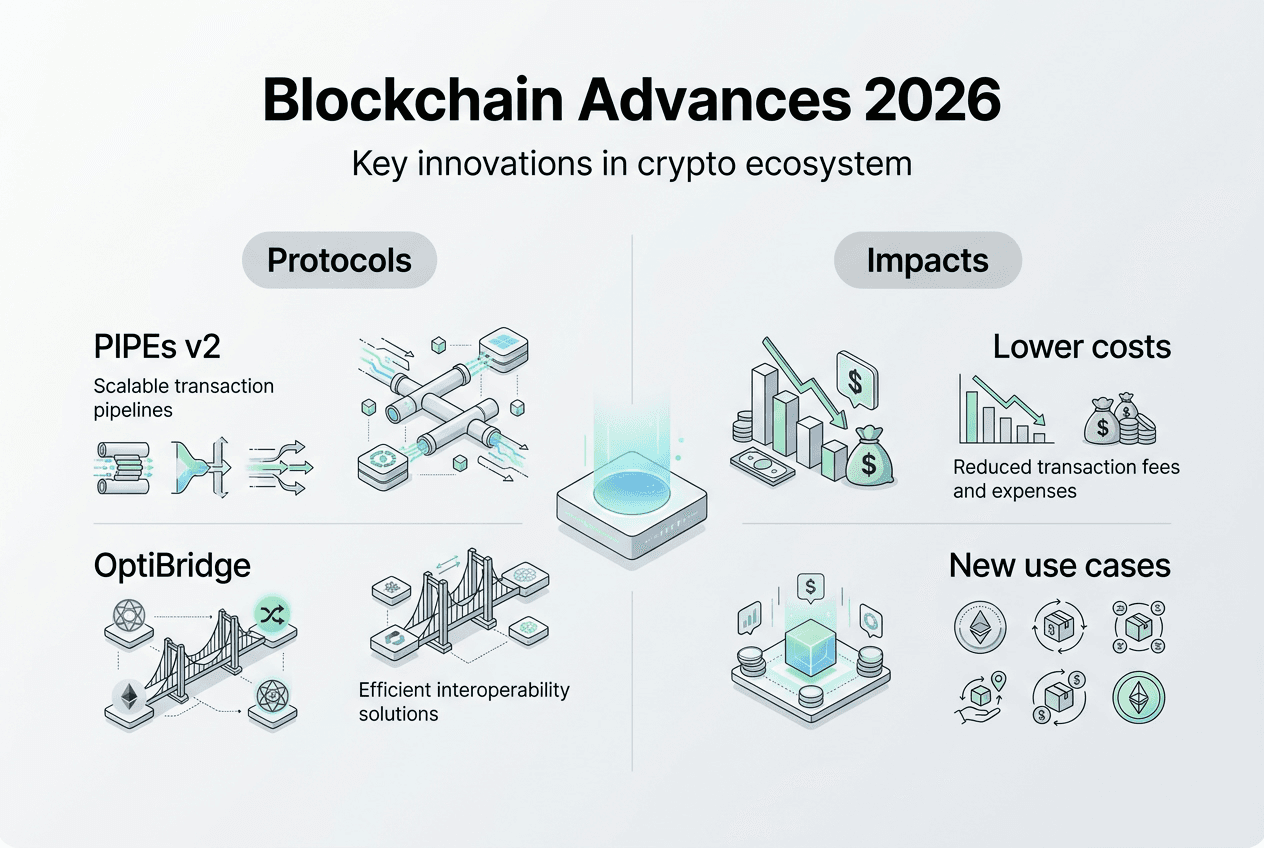
Cost reductions in bridges and proofs make decentralized finance products more economically viable. When verification costs drop from $14,000 to under $100, entire business models become possible. Projects can offer services to retail users instead of only serving institutions with deep pockets. This democratization of access accelerates adoption and brings blockchain benefits to broader audiences.
OptiBridge preserves safety and liveness without added trust assumptions, which is critical for decentralized finance interoperability. Users can move assets between chains confidently, knowing their funds remain secure without relying on centralized custodians. This trustless interoperability is essential for the vision of a connected, multi-chain ecosystem where liquidity flows freely.
Tech professionals have new opportunities to build innovative applications. ZkRollups on Bitcoin can scale transaction throughput while inheriting Bitcoin’s security. Cross-chain bridges can connect previously isolated ecosystems, enabling novel financial products. Privacy-preserving credentials can verify user attributes without exposing personal data. Each innovation opens new design spaces for creative developers.
Future trends point toward growing collaboration across blockchain ecosystems. As technical barriers fall, projects will focus more on user experience and real-world utility rather than working around platform limitations. Efficiency improvements will continue as researchers optimize cryptographic protocols and developers implement best practices learned from early deployments.
Understanding these developments provides strategic advantages:
- Identify investment opportunities in projects leveraging new capabilities
- Evaluate technical claims by assessing whether protocols avoid trusted setups
- Anticipate market shifts as cost reductions enable new business models
- Position yourself as an informed professional in blockchain technology discussions
- Recognize which innovations solve real problems versus marketing hype
The blockchain innovation market impact extends beyond cryptocurrency trading. Industries exploring supply chain transparency, digital identity, and decentralized computing will benefit from these foundational improvements. Staying informed about technical advances helps you recognize when blockchain offers genuine solutions versus situations where traditional databases suffice.
Explore more blockchain insights and market analysis
These innovations represent just the beginning of blockchain’s evolution in 2026. DailyTouch provides comprehensive coverage of emerging technologies, market trends, and practical applications to keep you ahead of developments. Our crypto market analysis March 2026 breaks down price movements, regulatory changes, and institutional adoption patterns with actionable insights.

Whether you’re new to blockchain or an experienced developer, our blockchain beginner’s guide 2026 explains core concepts clearly without unnecessary jargon. We cover everything from consensus mechanisms to smart contract security. For strategic planning, explore our analysis of blockchain trends 2026 showing how businesses integrate these technologies to gain competitive advantages. Stay informed with DailyTouch’s reliable reporting on the innovations shaping tomorrow’s digital economy.
Frequently asked questions
What are programmable covenants in blockchain?
Programmable covenants are script-based conditions that define how and when cryptocurrency can be spent, allowing flexible control beyond simple transfers. They enable use cases like time-locked funds, multi-signature requirements, and conditional payments based on external data. PIPEs v2 enables such programmable covenants on Bitcoin without protocol upgrades or soft forks, using cryptographic techniques to enforce spending rules off-chain.
How does OptiBridge reduce costs in blockchain bridging?
OptiBridge uses optimistic contract deployment, activating expensive dispute contracts only on demand when fraud is detected. In the common case where all participants act honestly, only minimal contracts deploy, lowering average gas fees by approximately 73% compared to previous protocols. This approach maintains strong security guarantees while making cross-chain transfers economically practical for everyday users.
Why are witness encryption schemes important in blockchain proofs?
Witness encryption locks keys or proofs under hard NP statements, enabling secure on-chain and off-chain verification without revealing sensitive information. This cryptographic technique allows protocols to verify complex conditions efficiently while maintaining privacy. Protocols like BABE leverage witness encryption to reduce storage and setup costs by three orders of magnitude compared to previous methods, making advanced applications economically viable.
Can Bitcoin now compete with Ethereum for smart contracts?
Bitcoin’s new capabilities through PIPEs v2 and similar protocols enable sophisticated programmable logic without changing its core design. While Ethereum offers more flexible native scripting, Bitcoin’s approach provides security advantages by keeping the base layer simple. The choice depends on specific application requirements, with Bitcoin excelling in security-critical use cases and Ethereum offering broader programmability for complex decentralized applications.
What skills do developers need to build with these new protocols?
Developers should understand cryptographic primitives like zero-knowledge proofs, witness encryption, and secure multi-party computation. Familiarity with Bitcoin’s UTXO model and scripting limitations helps contextualize how protocols like PIPEs v2 work around constraints. Smart contract development experience on platforms like Ethereum provides useful background, though Bitcoin-specific knowledge becomes essential for optimization and security auditing.
Recommended
- Why blockchain matters in 2026: Trust and innovation
- Blockchain vs traditional finance: differences in 2026
- Blockchain trends 2026: 65% North American firms boost ROI
- Why Use Blockchain in 2026: Unlock $16T Asset Market
